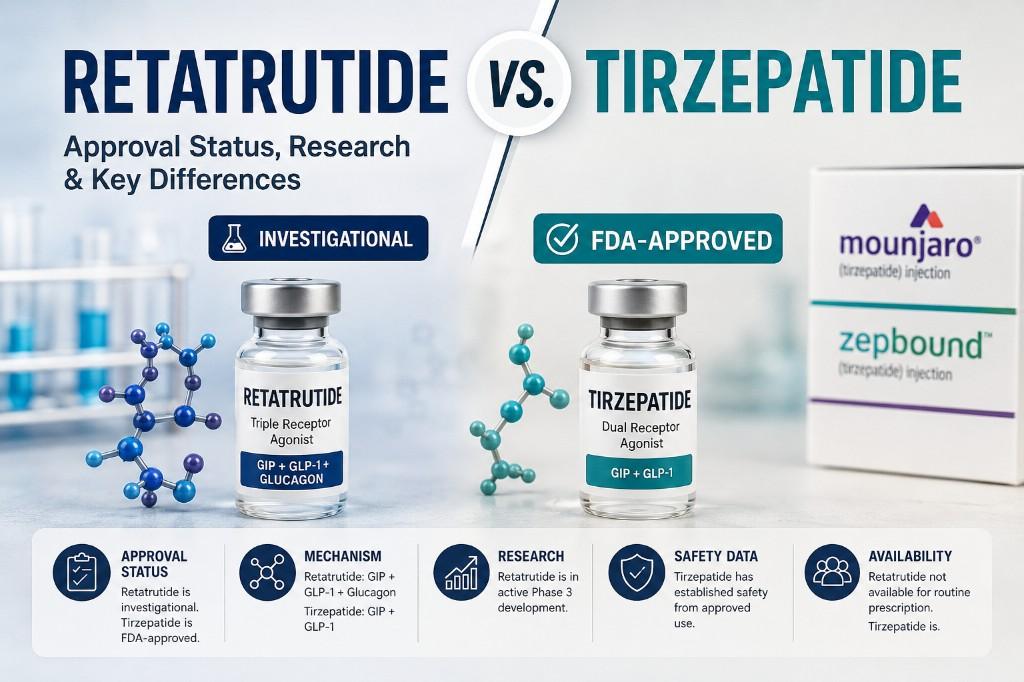
Retatrutide and Tirzepatide are not equivalent treatment options. Tirzepatide is the active ingredient in FDA-approved prescription medications including Mounjaro and Zepbound. Retatrutide remains an investigational drug and is not FDA-approved for any medical use. FDA also states that Retatrutide cannot currently be used in compounding under federal law.
The two medications are often discussed together because both affect hormone pathways involved in metabolism, appetite, glucose regulation, and body weight. But similarities in research interest do not mean they have the same regulatory status, evidence base, safety information, or clinical availability.
If you want a deeper introduction to each medication before comparing them, start with What Is Tirzepatide? and What Is Retatrutide?.
Tirzepatide has FDA-approved products with established prescribing information, indications, contraindications, warnings, and pharmacy pathways. Retatrutide is still being evaluated through clinical research. That difference should come before any discussion about receptors, weight-management results, or which medication appears more promising.
At Drip Lounge, emerging metabolic treatments should be discussed in context rather than presented as interchangeable products. Patients interested in the broader category can also explore our Peptide Wellness education hub.
Written by: Drip Lounge Editorial Team
Medically reviewed by: Megan Nickerson, DNP · Last medically reviewed: August 2026
Regulatory status reviewed: August 21, 2026
Medical disclaimer: This article is for educational purposes only. It does not provide individual medical advice, recommend one medication over another, provide dosing instructions, or suggest that Retatrutide is available for routine prescription treatment. Medication decisions should be made with a qualified healthcare professional.
Retatrutide vs. Tirzepatide at a Glance
| Question | Retatrutide | Tirzepatide |
|---|---|---|
| FDA-approved? | No | Yes, in specific FDA-approved products |
| Regulatory status | Investigational | Approved active ingredient |
| FDA-approved brands | None | Mounjaro and Zepbound |
| Receptor activity | GIP + GLP-1 + glucagon | GIP + GLP-1 |
| Routine prescription availability | No FDA-approved product | Yes, when clinically appropriate |
| FDA prescribing information | None | Yes |
| Can it be compounded? | FDA says no under federal law | Separate federal requirements and FDA policies apply |
| Clinical research | Active Phase 3 development | Extensive completed and ongoing research |
| FDA-approved product available today? | No | Yes, when clinically appropriate |
FDA states that Retatrutide is not a component of an FDA-approved drug, has not been found safe and effective for any condition, and cannot be used in compounding under federal law. That is the most important difference between the two medications today.
What Is Tirzepatide?
Tirzepatide is a prescription medication that activates two hormone receptors:
- glucose-dependent insulinotropic polypeptide, or GIP
- glucagon-like peptide-1, or GLP-1
It is therefore known as a dual GIP and GLP-1 receptor agonist. These pathways are involved in glucose regulation, insulin signaling, appetite, food intake, and digestion.
Tirzepatide is the active ingredient in FDA-approved medications Mounjaro and Zepbound. For a deeper explanation of the medication's mechanism and approved brands, see What Is Tirzepatide? Uses, How It Works and FDA-Approved Brands.
Mounjaro
Mounjaro is FDA-approved as an adjunct to diet and exercise to improve glycemic control in people with type 2 diabetes. Current FDA labeling also includes pediatric patients 10 years of age and older with type 2 diabetes.
Zepbound
Zepbound contains the same active ingredient but has different approved uses. It is FDA-approved, along with reduced-calorie nutrition and increased physical activity, for long-term weight reduction and maintenance in eligible adults with obesity or overweight plus at least one weight-related condition. Zepbound is also FDA-approved for moderate-to-severe obstructive sleep apnea in adults with obesity.
The important takeaway is: Tirzepatide is the active ingredient. Mounjaro and Zepbound are FDA-approved products containing Tirzepatide, but their labeled uses differ.
People specifically considering this pathway can learn more about Tirzepatide for weight management or review the Tirzepatide treatment information page.
FDA approval does not mean Tirzepatide is appropriate for everyone. Eligibility still depends on diagnosis, medical history, medications, contraindications, and clinician assessment.
What Is Retatrutide?
Retatrutide, also known in research as LY3437943, is an investigational medication being developed by Eli Lilly. Unlike Tirzepatide, Retatrutide activates three receptor pathways:
- GIP
- GLP-1
- glucagon
It is therefore described as a triple hormone receptor agonist. Published Phase 2 research has investigated Retatrutide's effects on body weight and metabolic outcomes, which has generated substantial scientific and consumer interest. But clinical-trial results do not equal regulatory approval.
As of August 2026:
- Retatrutide has no FDA-approved indication.
- There is no FDA-approved Retatrutide brand.
- There is no FDA-approved prescribing information for routine clinical use.
- There is no FDA-approved commercial product.
- FDA states it cannot currently be used in compounding under federal law.
Calling Retatrutide a “new weight-loss medication available now” would therefore be inaccurate. It remains an investigational drug in clinical development. For a dedicated explanation of its current research and regulatory status, read What Is Retatrutide?.
The Biggest Difference: FDA Approval Status
For someone comparing Retatrutide vs. Tirzepatide, regulatory status should come before mechanism or headline trial results.
What FDA Approval Means
FDA approval means the agency has reviewed evidence supporting a specific product for specific uses and approved corresponding prescribing information, indications, contraindications, warnings, adverse-reaction information, manufacturing requirements, and labeling. That does not make a medication risk-free. It means an established regulatory framework exists for how the approved product can be marketed and prescribed.
Tirzepatide has that framework through Mounjaro and Zepbound.
What Investigational Means
An investigational medication is still undergoing clinical development. Research may already show interesting or promising findings, but important questions may remain about long-term safety, adverse effects, optimal clinical use, appropriate populations, comparative effectiveness, manufacturing standards, labeling, and the final balance of benefits and risks.
Retatrutide remains in this category. An investigational medication should therefore not be treated as a routine alternative to an FDA-approved treatment.
How Do Retatrutide and Tirzepatide Work Differently?
Mechanistically, the major difference is the number of receptor pathways they target.
| Mechanism | Tirzepatide | Retatrutide |
|---|---|---|
| GIP receptor | Yes | Yes |
| GLP-1 receptor | Yes | Yes |
| Glucagon receptor | No | Yes |
| Regulatory context | FDA-approved products | Investigational |
Tirzepatide: Dual Agonism
Tirzepatide activates GIP and GLP-1 receptors. GLP-1 signaling affects appetite, food intake, glucose-dependent insulin secretion, and gastric emptying. GIP also participates in glucose-dependent metabolic signaling after food intake. Their combined activity is what makes Tirzepatide a dual agonist.
Retatrutide: Triple Agonism
Retatrutide adds glucagon receptor activity to GIP and GLP-1 signaling. Glucagon is traditionally associated with glucose regulation, but it also participates in energy metabolism. Researchers are studying whether adding glucagon receptor activation may influence metabolic outcomes beyond dual GIP/GLP-1 activity.
But this needs an important qualification: more receptor pathways do not automatically mean a medication is better, safer, or more appropriate. Mechanistic complexity is not the same thing as proven clinical superiority.
People interested in other emerging metabolic peptides may also encounter MOTS-c, but it belongs to a completely different research category and should not be treated as interchangeable with either medication.
Is Retatrutide Better Than Tirzepatide?
There is currently no responsible basis for making a universal claim that Retatrutide is better than Tirzepatide. That question is popular because separate studies of each medication have reported substantial weight-related outcomes. But comparing headline percentages from unrelated clinical trials can be misleading.
Different trials may involve different participant populations, inclusion criteria, baseline characteristics, treatment durations, protocols, comparator groups, endpoints, and statistical methods. A percentage from one Tirzepatide trial cannot simply be placed beside a percentage from one Retatrutide trial and interpreted as a head-to-head result.
A Direct Comparison Is Being Studied
The Phase 3 program includes TRIUMPH-5, a randomized study directly comparing Retatrutide with Tirzepatide in adults with obesity. The existence of a head-to-head study is scientifically important, but until complete high-quality evidence is available and appropriately reviewed, claims such as “Retatrutide works better,” “Retatrutide is stronger,” “Retatrutide is safer,” or “Retatrutide replaces Tirzepatide” should be treated cautiously.
Even future head-to-head results would not automatically establish which treatment is best for every individual.
What Does Current Retatrutide Research Show?
Retatrutide has progressed beyond basic laboratory research. Published Phase 2 studies have evaluated it in obesity and type 2 diabetes, and those findings helped support advancement into Phase 3 development. Current research programs examine areas including obesity, weight maintenance, metabolic disease, cardiovascular and kidney outcomes, type 2 diabetes, and direct comparison with Tirzepatide.
This is meaningful clinical research. But it should still be described accurately: Retatrutide is a promising investigational medication being evaluated in late-stage trials. It is not yet an FDA-approved treatment. For a broader explanation of the research rather than a direct comparison, see What Is Retatrutide? Research, Trials and FDA Status.
Is Retatrutide FDA-Approved?
No. As of August 2026, Retatrutide is not FDA-approved for obesity, chronic weight management, type 2 diabetes, metabolic disease, cardiovascular disease, sleep apnea, or any other condition. Clinical-trial progress should not be confused with approval.
Terms such as Phase 3, positive study, promising results, pipeline candidate, and late-stage development refer to stages of drug development. They do not mean a product has been approved for routine clinical prescribing.