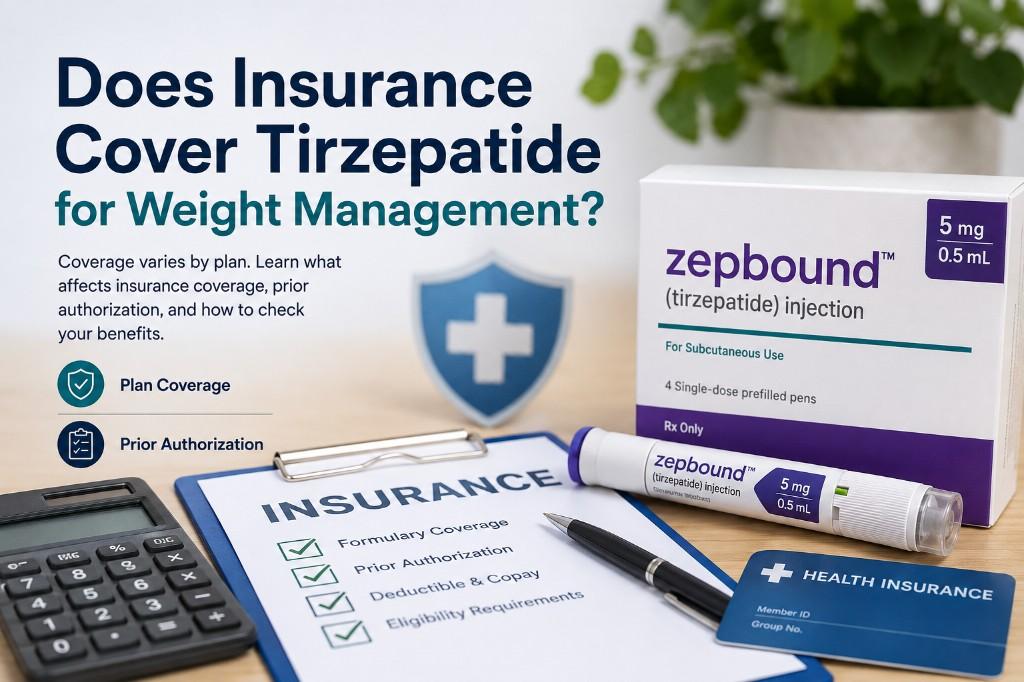
Insurance may cover Tirzepatide for weight management in some circumstances, but coverage varies significantly by plan. Your insurer may consider the specific medication, FDA-approved indication, formulary, employer benefits, diagnosis, clinical criteria, prior-authorization requirements, pharmacy network, deductible, and other plan rules before deciding whether a prescription is covered.
For weight management, the FDA-approved Tirzepatide brand is Zepbound. Mounjaro contains the same active ingredient — Tirzepatide — but has a different FDA-approved indication related to type 2 diabetes. If the distinction between the ingredient and brand names is confusing, our guide to what Tirzepatide is and how it works explains it in more detail.
Even when a medication has FDA approval for a particular condition, an insurance company is not automatically required to cover it. A health plan may cover Zepbound, exclude weight-management medications altogether, require prior authorization, apply step therapy, restrict pharmacy access, or require the patient to meet specific clinical criteria.
At Drip Lounge, the first question is whether a treatment may be medically appropriate. Insurance coverage is a separate determination that must be verified with the individual insurer or pharmacy benefit manager.
Written by: Drip Lounge Editorial Team
Medically reviewed by: Megan Nickerson, DNP · Last medically reviewed: August 2026
Last reviewed for coverage information: August 26, 2026
Important: This article provides general educational information only. It does not guarantee insurance coverage, prior-authorization approval, pharmacy availability, a specific copay, or a prescription. Coverage rules can change and must be confirmed directly with your insurance plan.
Tirzepatide Insurance Coverage at a Glance
| Question | Short Answer |
|---|
| Does insurance cover Tirzepatide? | Some plans may; others may not |
| Which Tirzepatide brand is FDA-approved for weight management? | Zepbound |
| Is Mounjaro the same medication? | Same active ingredient, different FDA-approved indication |
| Does FDA approval guarantee insurance coverage? | No |
| Can prior authorization be required? | Yes |
| Can a plan exclude weight-management medications? | Yes |
| Can two people with the same insurer have different coverage? | Yes |
| Does “covered” mean there is no out-of-pocket cost? | No |
| Can Medicare beneficiaries have access in 2026? | Some eligible Part D beneficiaries may qualify through the Medicare GLP-1 Bridge |
| Who makes the final coverage decision? | The patient's insurance program or applicable coverage administrator |
The most useful way to think about the process is: Clinical eligibility ≠ FDA approval ≠ insurance coverage. All three matter, but they answer different questions.
Which Tirzepatide Product Is FDA-Approved for Weight Management?
Tirzepatide is the active ingredient, not the brand name. Two well-known FDA-approved medications contain Tirzepatide:
| Product | Active Ingredient | General FDA-Approved Context |
|---|
| Zepbound | Tirzepatide | Long-term weight reduction and maintenance in eligible adults, alongside reduced-calorie nutrition and increased physical activity |
| Mounjaro | Tirzepatide | Improving glycemic control in people with type 2 diabetes, alongside diet and exercise |
FDA originally approved Zepbound for adults with obesity or adults with overweight and at least one weight-related condition, alongside reduced-calorie nutrition and increased physical activity.
The difference matters for insurance. A plan's policy may depend on which branded medication is prescribed, why it is being prescribed, the patient's diagnosis, whether that indication is covered, and whether the plan's clinical criteria are satisfied.
Someone researching treatment specifically for body-weight management may also find our Tirzepatide for Weight Management guide useful before beginning the insurance-verification process.
Does FDA Approval Mean Insurance Has to Cover Tirzepatide?
No. FDA approval and insurance coverage are separate. FDA evaluates whether a specific drug is approved for a particular use based on its regulatory review. Insurance companies and benefit programs make separate decisions about whether and under what circumstances they will pay for it.
A plan may cover Zepbound; cover it only after prior authorization; require step therapy; place it on a non-preferred formulary tier; restrict which pharmacy can fill it; impose quantity limits; require periodic renewal; or exclude weight-management medications altogether.
This is why simply asking “Does Blue Cross cover Tirzepatide?” or “Does UnitedHealthcare cover Zepbound?” often does not produce a reliable answer. Two people may have the same insurance company but completely different employer-sponsored plans, formularies, deductibles, and pharmacy benefits.
Why Tirzepatide Insurance Coverage Varies
Several layers can influence whether Zepbound is covered and what the patient ultimately pays.
Your Specific Health Plan
An insurer may administer thousands of different plans. Employer A might include weight-management medications while Employer B excludes them, even when both plans use the same insurance company. Coverage can vary according to employer benefit design, individual vs. employer-sponsored coverage, state, deductible, pharmacy-benefit manager, plan year, and formulary. Always check the exact plan you currently have.
Formulary Status
A formulary is the list of medications covered under a prescription-drug plan. Zepbound might be preferred, non-preferred, covered with restrictions, subject to prior authorization, or excluded. Formularies can also change during annual benefit updates.
The FDA-Approved Indication
Insurers may evaluate why the medication is being prescribed. For weight-management treatment, Zepbound — not simply the generic concept of “Tirzepatide” — is the relevant FDA-approved product. The clinical diagnosis documented by the prescriber may therefore matter.
Prior Authorization
A plan may require prior authorization, often shortened to PA. This means the insurer asks for clinical information before deciding whether to cover the medication. Prior authorization is a review process. It is not a promise of approval.
Step Therapy
Some insurance plans may require the patient to have tried another intervention or medication before considering coverage for Zepbound. Specific requirements vary by plan.
Pharmacy Network
Your plan may require you to use an in-network retail pharmacy, a preferred pharmacy, mail order, or another designated pharmacy channel. Using a different pharmacy can affect coverage or cost.
Deductible, Copay, and Coinsurance
A medication can technically be covered while still having substantial out-of-pocket costs. You may encounter:
- Deductible: the amount you pay before certain benefits begin.
- Copay: a fixed amount for a covered service or medication.
- Coinsurance: a percentage of the cost for which you are responsible.
The only reliable way to estimate your cost is to check your own current benefits.
What Might Insurance Require for Zepbound?
Prior-authorization requirements differ between plans, but insurers may request documentation relevant to their coverage policy. Examples can include medication requested, diagnosis, FDA-approved indication, current height and weight, BMI when relevant, weight-related medical conditions, medical history, previous treatments, clinical documentation, lifestyle-management history if required, clinician notes, follow-up information, step-therapy documentation, or use of an approved pharmacy.
FDA's original Zepbound weight-management approval included adults with a BMI of 30 kg/m² or greater, or 27 kg/m² or greater with at least one weight-related condition. But you should not assume your insurance company uses exactly the same criteria. A plan can have additional requirements.
So instead of assuming “My BMI is above 30, therefore insurance has to cover it,” the safer conclusion is: “I may meet part of the medication's labeled clinical context, but I still need my clinician to assess eligibility and my insurance plan to confirm coverage.”
How to Check Whether Your Insurance Covers Tirzepatide
Step 1: Know Which Medication You Are Asking About
If your goal is weight management, ask your insurer about Zepbound rather than simply asking “Do you cover Tirzepatide?” That helps prevent confusion with Mounjaro. Before contacting insurance, you may want to review Tirzepatide for weight management so you understand the clinical context.
Step 2: Check Your Online Formulary
Log into your health-insurance portal, prescription-benefit portal, or pharmacy-benefit-manager account. Search for Zepbound and look for information about formulary tier, prior authorization, step therapy, quantity limits, pharmacy restrictions, exclusions, and other coverage notes. Save the page or take a screenshot because formularies can change.
Step 3: Call Member Services
Use the phone number on your insurance card. A useful script is: “I'm checking my prescription-drug coverage for Zepbound for chronic weight management. Is it on my formulary? Does prior authorization or step therapy apply? What clinical documentation is required? Are there any weight-management medication exclusions? Which pharmacies are in network, and how would my deductible, copay, or coinsurance apply?” Ask for the answer in writing or request the current policy document when possible.
Step 4: Ask Specifically About Weight-Management Exclusions
Do not assume that having prescription coverage means weight-management medications are included. Ask directly: “Does my plan exclude medications when prescribed for chronic weight management?” This one question can save substantial time.
Step 5: Ask About Prior Authorization
If PA is required, ask what criteria apply, what documentation is necessary, who submits it, how long approval lasts, whether renewal is required, and what happens if the request is denied.
Step 6: Verify Your Pharmacy
Ask which pharmacies are preferred or required. Coverage can occasionally change depending on which pharmacy is used.
Step 7: Discuss Clinical Eligibility
Insurance coverage does not establish whether Tirzepatide is medically appropriate. A qualified clinician still needs to consider your medical history, treatment goals, medications, contraindications, previous treatments, and individual risk profile. Anyone researching treatment should also understand the known adverse-effect profile. Our Tirzepatide Side Effects guide covers common symptoms, important warnings, and questions to discuss with a clinician.
Step 8: Recheck Before Filling the Prescription
Even after you receive an estimate, confirm current coverage, approval status, pharmacy, deductible, and expected cost. Insurance information can change.
What Is Prior Authorization for Zepbound?
Prior authorization is an insurer's review process before agreeing to cover certain treatments. A typical process may look something like this:
- A clinician evaluates whether an FDA-approved treatment may be medically appropriate.
- The patient or practice checks whether insurance requires prior authorization.
- Relevant clinical documentation is submitted.
- The insurer reviews the request.
- The insurer approves it, denies it, requests additional information, or applies another coverage condition.
- The patient reviews the decision with the clinical team, pharmacy, and insurer.
Prior authorization does not mean automatic approval, permanent approval, guaranteed pharmacy availability, guaranteed cost, or guaranteed renewal. The insurance company makes the coverage determination.
What If Prior Authorization Is Denied?
A denial does not always mean the process is finished. First, determine why the request was denied. Common categories can include medication excluded from the benefit, missing documentation, criteria not met, step therapy required, non-formulary status, pharmacy restrictions, or another administrative reason.
Depending on the plan, possible next steps may include providing additional requested documentation, requesting reconsideration, submitting an appeal, requesting a formulary exception, completing required step therapy, or discussing a different treatment with the clinician. None of these steps guarantees approval. The specific appeal or exception procedure is determined by your plan.
Does Medicare Cover Tirzepatide for Weight Management?
This answer changed substantially in 2026. CMS launched the Medicare GLP-1 Bridge on July 1, 2026. The temporary program is currently scheduled to run through December 31, 2027 and provides certain eligible Medicare Part D beneficiaries access to selected GLP-1-related medications for weight management.
This program operates outside the normal Medicare Part D benefit coverage and payment flow. CMS says Part D plans do not need to opt into the Bridge for eligible beneficiaries to use it.
Does the Medicare GLP-1 Bridge Include Zepbound?
Yes — but there is an important formulation restriction. Current CMS guidance lists Zepbound KwikPen as eligible under the Bridge for qualified beneficiaries using it to reduce excess body weight or maintain weight reduction. CMS explicitly states that the single-dose Zepbound pen and single-dose vial are not included under the Bridge at this time.
What Does the Medicare GLP-1 Bridge Cost?
As of August 2026, CMS states that eligible beneficiaries pay a $50 copay for covered medications furnished through the Medicare GLP-1 Bridge. The normal Part D deductible does not apply to these Bridge claims, and the payment does not count toward Part D true out-of-pocket costs. This is a specific current CMS program — not a general statement that “Medicare covers Zepbound for $50.” Eligibility rules still apply.
Important Medicare Limitation
CMS states that the Bridge is designed for eligible beneficiaries using these medications for weight reduction or weight-maintenance purposes. People using qualifying GLP-1 medications for certain other indications that are already eligible for Part D coverage — such as type 2 diabetes or moderate-to-severe obstructive sleep apnea — are handled through different Part D pathways rather than the Bridge.
Because this is a temporary program, Medicare information in this article should be rechecked frequently. Medicare coverage rules, formulations, clinical criteria, and costs can change. Confirm current information directly with Medicare before making a treatment or financial decision.
What If Your Insurance Does Not Cover Tirzepatide?
If coverage is unavailable, start by identifying the reason. Ask whether Zepbound is completely excluded, non-formulary, subject to prior authorization, subject to step therapy, or simply being processed incorrectly. Then discuss medically appropriate alternatives with your clinician.
Depending on your clinical situation, another FDA-approved strategy or another type of weight-management intervention may be more appropriate. Do not switch medications based only on insurance coverage. And do not respond to a coverage denial by purchasing Tirzepatide or similar compounds through an unverified online source.
This is particularly important because the broader peptide and metabolic-treatment market contains both FDA-approved medications and experimental or unapproved compounds. Our guide to peptide therapy safety explains why regulatory status and product sourcing matter.
Does Manufacturer Assistance Change Insurance Coverage?
Manufacturer savings or assistance programs may sometimes reduce costs for people who meet program criteria. However, eligibility can change; commercial-insurance requirements may apply; government-insured patients may be excluded from certain programs; benefits may have limits; and manufacturer terms can change. Do not assume you qualify based on a blog article. Check the manufacturer's current official program requirements directly. Manufacturer assistance also does not mean the underlying insurance plan covers the medication.
Can You Use an HSA or FSA for Tirzepatide?
HSA and FSA reimbursement rules depend on the account, medical expense, documentation, and applicable tax rules. A prescription drug used for an appropriate medical purpose may potentially qualify as an eligible medical expense, but this should be confirmed with your plan administrator, benefits administrator, tax professional, or current IRS guidance. Drip Lounge should not promise that a particular patient can use an HSA or FSA for Tirzepatide.
Questions to Ask Your Insurance Company
- Is Zepbound covered under my current prescription-drug benefit for chronic weight management?
- Is it on my formulary? What formulary tier applies?
- Does prior authorization apply? Is step therapy required?
- What clinical criteria must be documented?
- Does my plan exclude weight-management medications?
- Which pharmacies are in network? Are there quantity restrictions?
- Does approval expire or require renewal?
- How does my deductible apply? Is there a copay or coinsurance?
- Are different Zepbound formulations treated differently?
- If coverage is denied, what appeal or exception process is available?
- Can you send me the current coverage policy in writing?
Write down the date of the call, representative's name or ID, reference number, and what they told you. That documentation can be useful if information later conflicts.
Questions to Ask Your Clinician
- Is Tirzepatide appropriate for my medical history?
- Is there an FDA-approved indication relevant to my situation?
- What alternatives should we consider?
- What contraindications or warnings matter for me?
- What medications could interact with treatment?
- What side effects should I understand?
- What documentation might insurance require?
- What monitoring would treatment involve?
- What happens if the medication is not tolerated?
- What happens if insurance denies coverage?
- What other evidence-based approaches may fit my goals?
If you're still learning about peptide-based treatments generally, our beginner's guide to peptide therapy provides broader context on different peptide categories and why evidence and regulatory status differ.
Frequently Asked Questions
Does Insurance Cover Tirzepatide?
Sometimes. Coverage is plan-specific. Your plan may cover a Tirzepatide product, require prior authorization, restrict coverage to certain diagnoses, apply step therapy, or exclude weight-management medications. For chronic weight management, ask specifically about Zepbound.
Does Insurance Cover Zepbound?
Some insurance plans cover Zepbound while others exclude it or place restrictions on coverage. Check your current formulary and contact your pharmacy benefit manager for the most reliable answer.
Does FDA Approval Mean Insurance Has to Cover Zepbound?
No. FDA approval determines whether a product is approved for a particular use. Insurance companies make separate decisions about coverage and benefit design.
Is Mounjaro Covered for Weight Loss?
Mounjaro and Zepbound both contain Tirzepatide, but they have different FDA-approved indications. Do not assume that insurance coverage for Mounjaro under a diabetes benefit means it will be covered when used for another purpose. A clinician should determine the appropriate medication and indication.
What Is Prior Authorization for Zepbound?
Prior authorization is a review process in which an insurance program evaluates clinical documentation before deciding whether to cover the medication. Submitting a PA does not guarantee approval.
How Can I Check Whether Zepbound Is on My Formulary?
Log into your health-plan or pharmacy-benefit portal and search for Zepbound. Then look for coverage tier, prior authorization, step therapy, quantity limits, pharmacy restrictions, and exclusions. You can also call the member-services number on your insurance card.
How Do I Know What My Tirzepatide Copay Will Be?
Your cost depends on your plan. Ask your insurer or pharmacy benefit manager about deductible, copay, coinsurance, pharmacy network, formulary tier, and prior authorization. Do not rely on another patient's cost as an estimate of your own.
Does Medicare Cover Zepbound for Weight Management?
CMS currently operates the Medicare GLP-1 Bridge from July 1, 2026, through December 31, 2027. Eligible Medicare Part D beneficiaries may receive selected GLP-1-related medications for weight management through the demonstration. The current program includes Zepbound KwikPen, but not Zepbound single-dose pens or vials. Eligibility must be confirmed through the current CMS process.
How Much Is Zepbound Through the Medicare GLP-1 Bridge?
CMS currently states that eligible beneficiaries pay a $50 copay for medications furnished under the Bridge. This applies only to people and products meeting the program's current requirements and should not be interpreted as the general Medicare price for Tirzepatide.
Can a Telehealth Clinic Guarantee Tirzepatide Coverage?
No. A telehealth provider cannot guarantee clinical eligibility, a prescription, insurance approval, prior-authorization approval, medication availability, or final out-of-pocket cost.
Does a Tirzepatide Prescription Guarantee Insurance Coverage?
No. Clinical prescribing and insurance approval are separate decisions.
Related Tirzepatide and Peptide Education
Sources Reviewed
This article was reviewed using current primary sources:
- FDA: Zepbound approval and FDA-approved weight-management indication.
- FDA: Current Mounjaro prescribing information and updated 2026 indication.
- CMS: Medicare GLP-1 Bridge overview and current dates.
- CMS: Current Bridge medications and Zepbound formulation restrictions.
- CMS: July 2026 launch announcement and current $50 copay.
Coverage information reviewed: August 26, 2026. Because insurance formularies, CMS programs, prior-authorization rules, and benefit structures can change, this page should be reviewed at least every 90 days, and the Medicare section should be checked against CMS more frequently while the Bridge remains active.
The Bottom Line: Does Insurance Cover Tirzepatide?
Insurance may cover Tirzepatide for weight management, but there is no universal coverage rule. For chronic weight management, the relevant FDA-approved Tirzepatide product is Zepbound. Whether your plan pays for it depends on factors such as your specific insurance policy, formulary, employer benefit design, diagnosis, clinical criteria, prior authorization, step therapy, deductible, pharmacy network, and current plan rules.
FDA approval does not guarantee insurance coverage. And insurance coverage does not determine whether the medication is medically appropriate for you.
The most practical sequence is:
- Understand the FDA-approved treatment context.
- Discuss clinical eligibility with a qualified clinician.
- Check Zepbound on your exact formulary.
- Confirm prior-authorization requirements.
- Verify your pharmacy and expected cost.
- Reconfirm benefits before filling the prescription.
For eligible Medicare Part D beneficiaries, the Medicare GLP-1 Bridge has also changed the coverage landscape in 2026, but its requirements and formulation restrictions need to be verified carefully.
At Drip Lounge, a clinician-guided conversation can help determine whether FDA-approved weight-management care may be medically appropriate based on your history, medications, goals, and individual risk profile.
Book a Tirzepatide Consultation