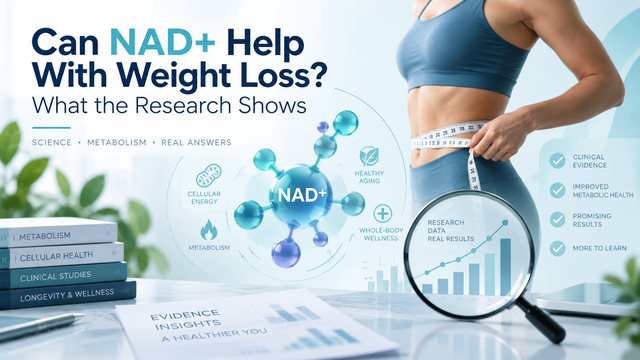
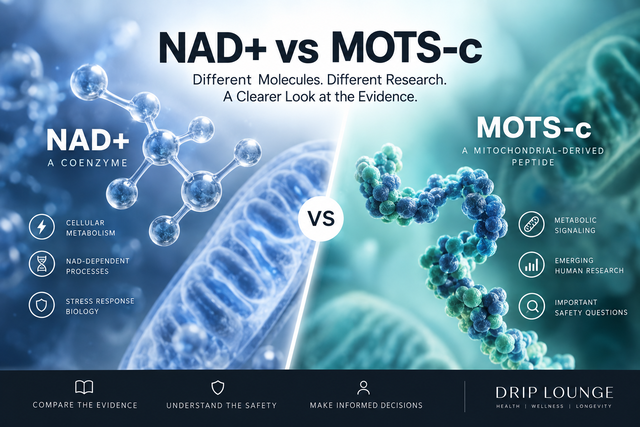
El NAD+ participa en el metabolismo de la energía celular, pero eso no significa que se haya demostrado que las inyecciones de NAD+, la terapia IV de NAD+ o los suplementos relacionados con NAD causen una pérdida de peso significativa o sostenida. Esa distinción es importante porque el NAD+ se comercializa cada vez más en torno a conceptos como:
- energía
- metabolismo
- salud celular
- longevidad
- recuperación
- y función mitocondrial.
Es comprensible que alguien que investigue esos beneficios termine preguntándose: ¿Puede el NAD+ ayudarme a perder peso? La evidencia hasta ahora no respalda el uso de inyecciones de NAD+ o terapia IV como tratamiento para la pérdida de peso. La mayoría de las investigaciones en humanos han estudiado precursores orales de NAD+ como el ribósido de nicotinamida (NR), el mononucleótido de nicotinamida (NMN), la nicotinamida o el ácido nicotínico, no el NAD+ inyectable o intravenoso. E incluso dentro de esa investigación, los hallazgos sobre el peso corporal, la composición corporal, la tasa metabólica y la oxidación de grasas son mixtos. En Drip Lounge, por lo tanto, las opciones relacionadas con NAD deben analizarse en su contexto real clínico o de bienestar en lugar de comercializarse como tratamientos para la pérdida de grasa. Si es completamente nuevo en el tema del NAD+, nuestra guía sobre qué es la terapia IV de NAD+ le explica los conceptos básicos antes de explorar formatos específicos de aplicación.
Escrito por: Equipo Editorial de Drip Lounge
Revisado médicamente por: Megan Nickerson, DNP
Última revisión médica: septiembre de 2026
Estado de evidencia y regulación revisado: septiembre de 2026
Nota médica: Las inyecciones de NAD+, la terapia IV de NAD+ y los suplementos relacionados con NAD no son tratamientos aprobados por la FDA para la obesidad o la pérdida de peso. Este artículo ofrece únicamente información educativa y no proporciona asesoramiento médico, guía de dosificación ni una recomendación de uso de NAD+ para el control de peso.
Importante: No utilice productos de NAD+ como sustitutos de una evaluación o tratamiento adecuado de la obesidad, cambios de peso inexplicables, diabetes, enfermedad tiroidea, trastornos de la conducta alimentaria, cambios de peso relacionados con medicamentos u otros problemas de salud.
NAD+ y la pérdida de peso de un vistazo
| Pregunta | Evidencia actual |
|---|---|
| ¿El NAD+ causa pérdida de peso? | No establecido |
| ¿Las inyecciones de NAD+ queman grasa? | Ninguna evidencia clínica sólida respalda esta afirmación |
| ¿El NAD+ IV causa pérdida de peso? | No establecido |
| ¿Las investigaciones relacionadas con NAD han examinado el metabolismo? | Sí |
| ¿La mayoría de los estudios en humanos son sobre NAD+ inyectable? | No: la mayoría involucra precursores orales |
| ¿El NR oral ha producido pérdida de peso en ensayos sobre obesidad? | No de manera constante |
| ¿La investigación sobre precursores ha mostrado un pequeño cambio en el IMC? | Algunos análisis agrupados sí lo han mostrado |
| ¿Eso se tradujo en una pérdida significativa de peso corporal? | No en el metanálisis de 2023 |
| ¿Es el NAD+ comparable a un medicamento GLP-1? | No |
| ¿Debería el NAD+ reemplazar el tratamiento de la obesidad basado en evidencia? | No |
La respuesta más simple es: el NAD+ desempeña una función biológica importante en el metabolismo energético. Esa función biológica no se ha traducido en evidencia sólida de que las inyecciones de NAD+ o la terapia IV causen una pérdida de peso clínicamente significativa.
La respuesta corta: ¿El NAD+ causa pérdida de peso?
Actualmente no existe evidencia sólida de que las inyecciones de NAD+ o la terapia IV de NAD+ produzcan una pérdida de peso significativa y sostenida. Una revisión sistemática y metarregresión de 2023 agrupó 22 brazos de tratamiento que involucraron a más de 5,000 participantes que recibieron precursores relacionados con NAD como ácido nicotínico o nicotinamida. Los investigadores encontraron una reducción promedio muy pequeña en el IMC de aproximadamente 0.19 kg/m². Sin embargo, no hubo una reducción estadísticamente significativa en el peso corporal real. Esa distinción es importante. Un pequeño cambio promedio en el IMC a lo largo de múltiples estudios no debe interpretarse como: “El NAD+ le hace perder peso”. Las intervenciones también involucraron compuestos precursores orales en lugar de inyecciones de NAD+ o infusiones IV estándar.
¿Por qué se asocia el NAD+ con el metabolismo?
NAD+ significa dinucleótido de nicotinamida y adenina. Es una coenzima natural que se encuentra en todo el cuerpo. El NAD+ participa en procesos celulares importantes que involucran:
Esta función científica ayuda a explicar por qué el NAD+ aparece con frecuencia en debates sobre:
- metabolismo energético
- reacciones de óxido-reducción
- función mitocondrial
- señalización celular
- y enzimas que dependen del NAD+ como sustrato.
- salud metabólica
- envejecimiento
- ejercicio
- energía
- y longevidad.
Pero existe una gran diferencia entre: “El NAD+ participa en el metabolismo de la energía celular” y “Administrar NAD+ a alguien causa pérdida de peso”. La primera afirmación refleja una biología establecida. La segunda requiere evidencia de resultados clínicos. La investigación actual no lo establece.
La energía celular no es lo mismo que la pérdida de grasa
Este es uno de los mayores malentendidos en la comercialización del NAD+.
| Afirmación común | Explicación basada en evidencia |
|---|---|
| “El NAD+ da energía a las células, por lo que causa pérdida de peso”. | El metabolismo celular no se traduce automáticamente en una reducción del peso corporal |
| “Más NAD+ significa un metabolismo más rápido”. | La regulación metabólica humana es mucho más compleja |
| “El NAD+ quema grasa”. | No se ha establecido el NAD+ inyectable o IV como un tratamiento para la pérdida de grasa |
| “Más energía significa más pérdida de peso”. | Los niveles de energía y los resultados de peso corporal son mediciones diferentes |
| “El NAD+ funciona como un GLP-1”. | El NAD+ y los agonistas del receptor de GLP-1 tienen mecanismos fundamentalmente diferentes |
| “La investigación sobre el NMN demuestra que las inyecciones de NAD+ funcionan”. | El NMN oral y el NAD+ inyectable son intervenciones diferentes |
Una persona puede sentirse con más energía, menos energía o no notar ningún cambio evidente después de un tratamiento de bienestar. Ninguna de esas experiencias subjetivas demuestra que se esté reduciendo la grasa corporal.
El NAD+, las inyecciones de NAD+, el NAD+ IV, el NMN y el NR son diferentes
Los artículos en línea a menudo confunden varios productos diferentes bajo el término “NAD”. Eso puede generar conclusiones engañosas.
| Producto | Qué es | Vía común de investigación/uso | Lo que no demuestra |
|---|---|---|---|
| NAD+ | Coenzima celular de origen natural | Presente de forma natural; también comercializado como IV/inyectable | Que administrar más cause pérdida de peso |
| Inyección de NAD+ | Preparado de NAD+ inyectable | Inyección | Que los estudios de precursores orales sean aplicables |
| Terapia IV de NAD+ | Administración de NAD+ intravenoso | Infusión IV | Que trate la obesidad |
| NMN | Precursor de NAD+ | Investigación principalmente oral | Que el NAD+ inyectado tenga el mismo resultado |
| NR | Precursor de NAD+ | Investigación principalmente oral | Que el NAD+ IV cause pérdida de grasa |
| Nicotinamida / niacina | Compuestos relacionados con la vitamina B3 | Principalmente oral | Que sus hallazgos se apliquen al NAD+ inyectable |
Una revisión sistemática de 2026 examinó 113 estudios relacionados con NAD, incluidos 33 estudios de intervención en humanos. El NR y el NMN orales modificaron con certeza los biomarcadores relacionados con NAD, pero los efectos clínicos en humanos sobre los resultados metabólicos, vasculares y de otros aspectos del bienestar fueron variables y con frecuencia nulos o específicos para variables de evaluación individuales. Lo más importante es que la revisión no encontró ensayos de resultados elegibles que evaluaran el NAD+ IV o intramuscular en sí mismo para resultados de antienvejecimiento o bienestar. Esa falta de evidencia también limita las afirmaciones sobre la pérdida de peso.
¿Qué dice la investigación sobre el NAD+ y el peso corporal?
La evidencia es mixta y depende en gran medida del compuesto que se esté estudiando.
Revisión sistemática de 2023: Pequeño cambio en el IMC, sin pérdida de peso significativa
La revisión sistemática de 2023 examinó ensayos clínicos aleatorizados que involucraban precursores de NAD+. En 22 brazos de tratamiento con 5,144 participantes, los investigadores informaron:
- cambio promedio en el IMC: −0.19 kg/m²
- ninguna reducción estadísticamente significativa del peso corporal general
- ningún cambio significativo en la leptina
- un aumento en la adiponectina.
Las intervenciones consistieron principalmente en ácido nicotínico y nicotinamida, no en inyecciones de NAD+ o terapia IV de NAD+. Por lo tanto, aunque el hallazgo sobre el IMC puede ser científicamente interesante, no establece al NAD+ inyectable como una terapia para el control de peso.
¿Qué sucedió cuando los investigadores estudiaron el NR en hombres con obesidad?
Un ensayo especialmente útil desafía la narrativa simple de que “el NAD aumenta el metabolismo”. Los investigadores realizaron un estudio aleatorizado, doble ciego y controlado con placebo en el que participaron 40 hombres sedentarios con obesidad. Los participantes recibieron ribósido de nicotinamida oral o placebo durante 12 semanas. Los investigadores examinaron directamente diversos resultados muy relevantes para la pérdida de peso, incluidos:
Los hallazgos fueron notables. La suplementación con NR no mejoró significativamente:
- composición corporal
- gasto energético en reposo
- sensibilidad a la insulina
- descomposición de grasa
- oxidación de lípidos
- metabolismo de la glucosa.
- composición corporal
- masa grasa total
- porcentaje de grasa
- gasto energético en reposo
- lipólisis
- oxidación de lípidos
- sensibilidad a la insulina
- o metabolismo de la glucosa.
Esto no demuestra que los compuestos relacionados con NAD nunca puedan afectar el metabolismo. Demuestra algo más importante: aumentar la actividad en una vía biológica relacionada con NAD no produce automáticamente una pérdida de grasa medible ni un aumento en la tasa metabólica.
¿Qué encontró la revisión sobre síndrome metabólico de 2024?
Una revisión sistemática y metanálisis de 2024 evaluó 19 ensayos controlados aleatorizados que involucraban precursores de NAD+. El análisis encontró reducciones en el colesterol total y los triglicéridos, pero la intervención no afectó de manera significativa la mayoría de los demás resultados del síndrome metabólico evaluados. Los investigadores también calificaron gran parte de la evidencia como de calidad muy baja a baja, citando riesgo de sesgo, reducido número de participantes, imprecisión e indirección. Eso respalda una vez más una interpretación cautelosa. La biología relacionada con NAD sigue siendo científicamente interesante. Los resultados clínicos son mucho menos dramáticos de lo que sugieren muchas afirmaciones de comercialización en línea.
¿Qué hay de la terapia IV de NAD+ para la pérdida de peso?
Actualmente no existe evidencia clínica de alta calidad que establezca la terapia IV de NAD+ como un tratamiento para la obesidad o la pérdida de peso. Eso significa que el NAD+ IV no debe comercializarse como:
- un suero quemador de grasa
- una IV supresora del apetito
- un acelerador del metabolismo
- un tratamiento para la obesidad
- una solución para superar el estancamiento en la pérdida de peso
- o una alternativa a los medicamentos aprobados para el control de peso.
Una revisión de 2026 sobre el NAD+ intravenoso concluyó que la evidencia disponible en humanos sigue siendo escasa y consiste principalmente en pequeños estudios no controlados, investigación observacional e informes de casos limitados. Los autores concluyeron que la evidencia sigue siendo insuficiente para establecer el uso rutinario de NAD+ IV como una práctica clínica basada en evidencia y señalaron preguntas no resueltas sobre la efectividad, durabilidad y seguridad a largo plazo. Las personas interesadas en el servicio real en lugar de afirmaciones sobre pérdida de peso pueden revisar la información sobre la Terapia IV de NAD+ de Drip Lounge. El servicio no debe interpretarse como un tratamiento para la obesidad.
¿Qué hay de las inyecciones de NAD+ para la pérdida de peso?
Se aplica la misma limitación. No hay suficiente evidencia clínica en humanos para afirmar que las inyecciones de NAD+ produzcan una pérdida de peso significativa o sostenida. La evidencia proveniente de:
- NR oral
- NMN oral
- ácido nicotínico
- nicotinamida
- o investigación en animales
no debe presentarse como si los investigadores hubieran administrado una inyección comercial de NAD+ y demostrado la pérdida de grasa en humanos. Si usted está investigando sobre inyecciones por razones ajenas al tratamiento de la obesidad, Drip Lounge proporciona información sobre su Kit de inyección de NAD+. Un profesional clínico debe determinar si la vía inyectable es adecuada según el historial de salud individual y el contexto del tratamiento. No debe seleccionarse como un atajo para la pérdida de peso.
¿El NAD+ aumenta el metabolismo?
Esta pregunta depende en gran medida de lo que alguien entienda por “metabolismo”. El NAD+ participa absolutamente en los procesos metabólicos celulares. Eso no significa que se haya demostrado que la terapia con NAD+ aumente la tasa metabólica en reposo de una persona lo suficiente como para causar pérdida de peso. El ensayo de 12 semanas con NR en hombres con obesidad examinó específicamente el gasto energético en reposo. Los investigadores no encontraron un beneficio significativo. Tampoco encontraron ningún aumento en:
- la oxidación de lípidos
- la descomposición de grasa
- o un cambio en la composición corporal.
Por lo tanto, decir: “El NAD+ estimula su metabolismo” sin explicar lo que eso significa puede ser engañoso. Una afirmación más precisa es: el NAD+ participa en el metabolismo energético celular, pero la evidencia clínica actual no establece que las inyecciones de NAD+ o la Terapia IV sean métodos confiables para aumentar la tasa metabólica o producir pérdida de peso.
¿El NAD+ quema grasa?
No existe evidencia sólida en humanos que demuestre que la Terapia IV de NAD+ o las inyecciones de NAD+ quemen grasa corporal. El metabolismo de las grasas implica muchos factores interconectados, que incluyen:
- ingesta de calorías
- gasto energético
- hormonas
- masa muscular
- actividad física
- sueño
- medicamentos
- genética
- afecciones médicas
- y factores conductuales.
Describir el NAD+ como una “molécula quemagrasa” simplifica en exceso tanto la biología como la evidencia.
¿El NAD+ suprime el apetito?
El NAD+ no es un tratamiento establecido para suprimir el apetito. No hay evidencia clínica sólida que demuestre que las inyecciones de NAD+ o la Terapia IV reduzcan de manera confiable el hambre, los antojos o la ingesta de alimentos de forma que produzcan una pérdida de peso sostenida. Esta es otra diferencia importante entre el NAD+ y ciertos medicamentos para la obesidad aprobados por la FDA.
El NAD+ no es lo mismo que un medicamento GLP-1
El NAD+ no debe describirse como: “una alternativa natural a los GLP-1”. Se trata de intervenciones fundamentalmente diferentes. El NAD+ es una coenzima de origen natural que participa en el metabolismo celular. Los agonistas del receptor de GLP-1 son medicamentos diseñados para activar un receptor hormonal específico y han sido evaluados a través de grandes programas de desarrollo clínico para indicaciones médicas definidas. Los medicamentos aprobados por la FDA para el control de peso incluyen actualmente varias clases de medicamentos diferentes, incluidos tratamientos basados en incretinas como semaglutide y tirzepatide. Eso no significa que esos medicamentos sean adecuados para todos. Significa que su evidencia y su estatus regulatorio son completamente diferentes de los productos de bienestar con NAD+.
¿Se puede usar NAD+ junto con un medicamento GLP-1?
No asuma que combinar una inyección de NAD+, Terapia IV o un producto oral relacionado con NAD+ con un medicamento recetado para el control de peso sea automáticamente útil o seguro. Un profesional clínico debe revisar:
- qué medicamento toma
- por qué lo toma
- otras afecciones médicas
- efectos secundarios
- hidratación
- nutrición
- presión arterial
- función renal
- otras recetas médicas
- suplementos
- y objetivos del tratamiento.
No existe buena evidencia que respalde afirmaciones amplias como: “El NAD+ mejora los resultados del GLP-1”. No se debe realizar esa afirmación.
¿Qué sucede si pierde peso después de comenzar con NAD+?
El peso puede cambiar por muchas razones. Los posibles factores contribuyentes incluyen:
Un cambio de peso ocurrido después del NAD+ no prueba que el NAD+ lo haya causado. Esto es especialmente importante con los cambios de peso a corto plazo en la báscula. El equilibrio de líquidos puede alterar el peso corporal sin reflejar una pérdida de grasa corporal. Si la pérdida de peso es:
- cambios en la ingesta de alimentos
- cambios en el equilibrio de líquidos
- enfermedad
- aumento o disminución de la actividad física
- síntomas digestivos
- estrés
- medicamentos
- otros tratamientos
- o fluctuaciones normales a corto plazo.
- rápida
- involuntaria
- persistente
- o viene acompañada de otros síntomas,
una evaluación médica puede ser adecuada.