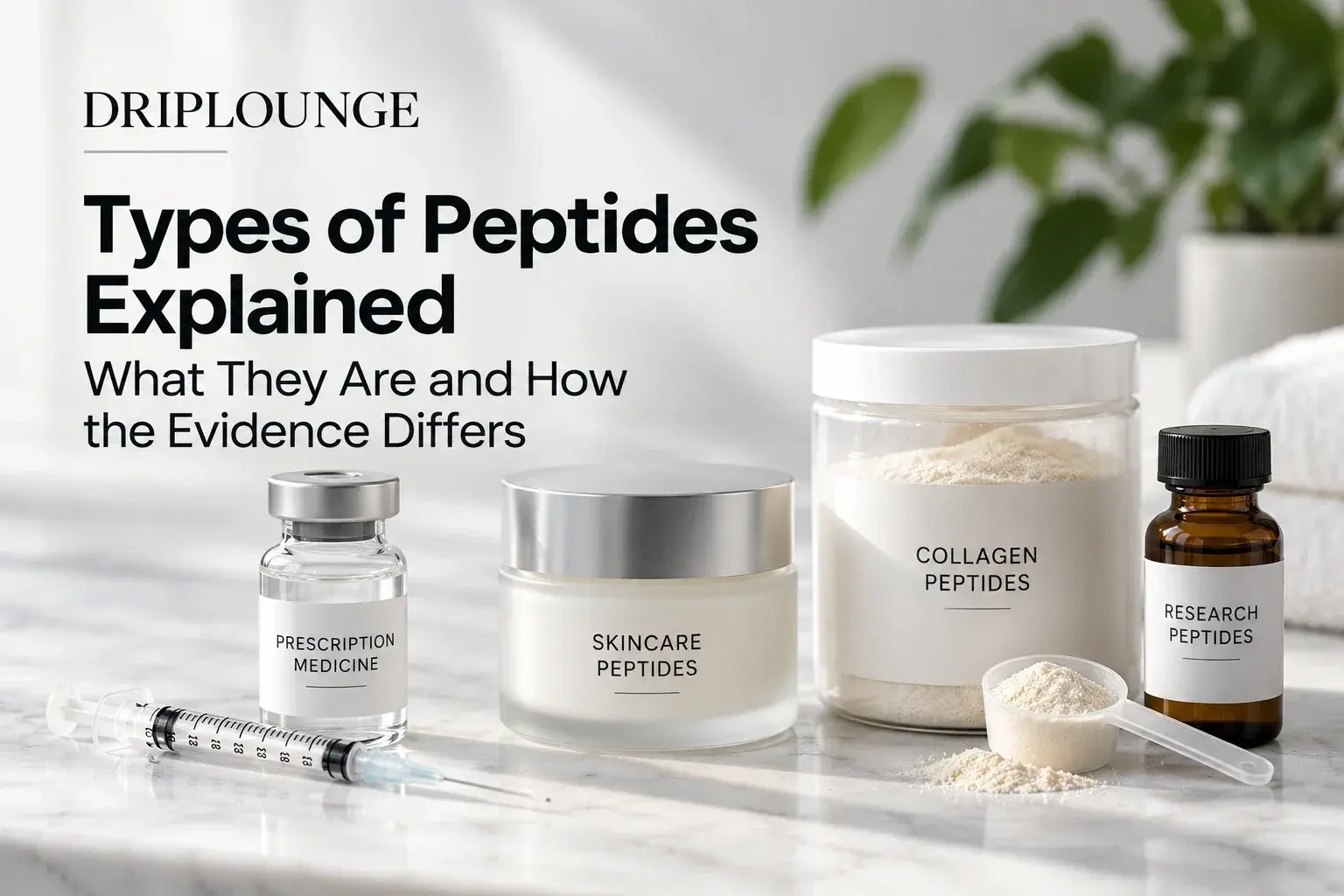
A prescription medication, an anti-aging face serum, a collagen powder, and a vial marketed for research may all contain peptides. But that doesn't mean they work the same way—or have the same evidence supporting them.
Some peptide-based medications have undergone extensive clinical trials and received FDA approval for specific medical conditions. Others are ingredients in skincare products or dietary supplements. Still others are experimental compounds being investigated for potential applications in recovery, metabolism, or longevity.
Understanding these differences is essential before deciding whether any peptide product deserves your attention.
The short answer: Peptides are chains of amino acids. The major product categories include prescription medicines, cosmetic skincare products, dietary supplements, and experimental compounds. Being called a peptide does not automatically make something safe, effective, FDA-approved, or suitable for a particular health goal.
In this guide, we'll explain the different types of peptides, how researchers evaluate them, and what to consider before exploring peptide-related wellness services.
What Are Peptides?
Peptides are molecules made of amino acids joined together by chemical bonds.
Amino acids are often described as the building blocks of proteins. When they connect in different sequences, they create molecules with different structures and biological functions.
Some peptides are naturally produced in the human body. Others are manufactured for use in medications, cosmetics, supplements, or scientific research.
For example, certain peptide hormones are involved in processes such as blood sugar regulation or communication between cells. Other peptides serve structural roles or participate in biological pathways that researchers are still investigating.
However, not every peptide functions as a signaling molecule, and not every naturally occurring peptide is beneficial when administered as a concentrated product.
How Are Peptides Different From Proteins?
Peptides and proteins both contain amino acids, but proteins generally have more complex structures and often contain longer amino-acid chains.
There isn't one universally accepted length that perfectly separates every peptide from every protein.
What matters clinically is the identity and behavior of the specific molecule.
Think of amino acids as letters. Changing their order can create entirely different words and meanings. Similarly, changing the amino-acid sequence of a peptide can produce a molecule with very different biological effects.
That is why two products described as peptides should never be assumed to have the same benefits or safety profile.
The Four Main Types of Peptide Products
The most practical way to understand peptide categories is to start with how the finished product is used, what evidence supports it, and how it is regulated.
| Product category | Common examples | What matters most |
|---|
| Prescription peptide medicines | Zepbound, Wegovy, Egrifta WR | FDA-approved indications, clinical evidence, contraindications, and prescribing information |
| Skincare peptides | Peptide-containing creams, serums, and copper-peptide cosmetics | Evidence for the finished topical product, cosmetic claims, and skin tolerability |
| Collagen peptide supplements | Hydrolyzed collagen powders, capsules, and drinks | Human studies, measured outcomes, product formulation, and study quality |
| Experimental peptides | BPC-157, TB-500, MOTS-c, CJC-1295, Semax | Human evidence, safety uncertainties, regulatory status, and product identity |
These categories are not interchangeable.
A prescription medicine is evaluated differently from a cosmetic. A dietary supplement is regulated differently from a drug. An experimental substance is not automatically an approved treatment simply because a healthcare provider discusses it.
One additional distinction is important: compounding is a way of preparing medications, not a separate scientific category of peptides. A compounded medication is not FDA-approved, even when it contains an ingredient also found in an approved drug.
1. Prescription Peptides: Medications With Specific Approved Uses
Some of the best-studied peptide-based products are prescription medicines.
These medications have been evaluated for defined medical conditions, using specified formulations and routes of administration.
But FDA approval applies to a particular drug product and its approved indications—not to every product containing the same active ingredient or to every possible use.
Tirzepatide: A Dual GIP and GLP-1 Receptor Agonist
Tirzepatide acts on two hormone-related receptors involved in metabolic regulation: GIP and GLP-1.
It is the active ingredient in FDA-approved medications including:
- Mounjaro, approved for glycemic management in patients with type 2 diabetes who meet its labeled criteria.
- Zepbound, approved for chronic weight management in eligible adults and for moderate-to-severe obstructive sleep apnea in adults with obesity.
The precise indication, warnings, and eligibility requirements depend on the branded product.
For readers considering medical weight management, Drip Lounge provides information about tirzepatide and its provider-guided program.
Importantly, Drip Lounge's described compounded tirzepatide offering should not be confused with FDA-approved Zepbound or Mounjaro. Clinical trial results for the approved branded products do not establish that a different compounded formulation has undergone equivalent evaluation.
Semaglutide: A GLP-1 Receptor Agonist
Semaglutide is another peptide-based active ingredient used in prescription medications.
FDA-approved semaglutide products include Wegovy and Ozempic, although their labeled indications differ.
For example, Wegovy has approved uses involving chronic weight management in eligible patients and cardiovascular risk reduction in specified populations. Its prescribing information also includes a particular liver-disease indication under accelerated approval.
This does not mean semaglutide should be used for every condition associated with metabolism, or that all semaglutide formulations are interchangeable.
If you're comparing metabolic treatments, you can explore Drip Lounge's semaglutide information.
Tesamorelin: Why the Exact Indication Matters
Tesamorelin provides another example of why broad peptide categories can be misleading.
The FDA-approved medication Egrifta WR contains tesamorelin and is indicated for reducing excess abdominal fat in adults with HIV-associated lipodystrophy.
Its prescribing information explicitly states that it is not indicated for general weight-loss management.
Describing tesamorelin simply as a "fat-loss peptide" would therefore leave out a medically important distinction.
The key lesson: Evidence supporting an FDA-approved medicine for one condition does not establish that the same ingredient works for unrelated wellness or performance goals.
Sources: FDA Zepbound prescribing information and FDA Egrifta WR prescribing information.
2. Skincare Peptides: Why the Formulation Matters
Peptides are increasingly common ingredients in cosmetic skincare products, particularly those marketed for improving the appearance of aging skin.
You may encounter them in moisturizers, serums, eye creams, and other topical formulations.
Manufacturers may make cosmetic claims related to skin hydration, smoothness, texture, or the appearance of fine lines.
But what does the research actually show?
What Does the Evidence Say About Peptide Skincare?
A 2026 systematic review and meta-analysis examined randomized controlled trials involving oral and topical peptide products for signs of skin aging.
The review reported some favorable findings for hydration, brightness, and wrinkle-related outcomes. However, results for skin elasticity and density were inconsistent, and the analysis included only two high-quality topical peptide studies.
This matters because findings driven largely by oral products cannot automatically establish the benefits of a particular topical cream.
When evaluating a skincare product, ask whether researchers tested the actual finished formulation.
A study of one ingredient does not necessarily establish that a commercial cream containing multiple ingredients will produce the same result.
What About Copper Peptides Such as GHK-Cu?
GHK-Cu is a copper-binding peptide discussed in cosmetic skincare and experimental biomedical research.
Some topical cosmetic formulations contain copper-peptide ingredients.
However, it is important to distinguish topical skincare research from the use of injectable GHK-Cu.
The FDA has identified limited human safety information for injectable GHK-Cu and potential concerns involving immune reactions, peptide aggregation, and impurities.
Consequently, evidence related to a topical skincare formulation should not be used to claim that injectable GHK-Cu improves skin, regenerates tissue, or restores hair growth.
If you encounter claims about GHK-Cu and skin or hair applications, evaluate the exact formulation, administration route, and quality of supporting human research.
Bottom line: A peptide-containing face cream and an injectable peptide product are fundamentally different products from an evidence and safety perspective.
Source: 2026 systematic review of oral and topical peptides for skin aging.
3. Collagen Peptides: Supplements Are Not Peptide Injections
Collagen peptides are among the most widely recognized peptide ingredients in the consumer wellness market.
They are commonly found in dietary supplements marketed for skin appearance, joint comfort, and general wellness.
Most collagen peptide supplements contain hydrolyzed collagen—collagen that has been broken down into smaller peptide fragments.
These products are consumed orally and digested through the gastrointestinal system.
They should not be confused with prescription peptide medications or experimental injectable compounds.
Do Collagen Peptides Actually Work?
Research on collagen supplements has produced mixed findings.
Some randomized trials have reported improvements in measurements such as skin hydration or elasticity.
However, study quality, funding, product composition, and treatment duration can significantly influence the results.
A 2025 systematic review and meta-analysis in The American Journal of Medicine evaluated 23 randomized controlled trials involving 1,474 participants.
Although the overall analysis initially found favorable effects on skin-related outcomes, those effects were not evident in the subgroup of studies without industry funding. Higher-quality studies also failed to show significant improvements in the evaluated categories.
More recent reviews have identified some positive findings but continue to highlight methodological limitations, including differences in formulations, short follow-up periods, and potential bias.
This means collagen supplementation remains an area where the strength and consistency of evidence deserve careful attention.
What About Hair Growth, Joint Recovery, or Injury Healing?
Evidence for one outcome does not automatically establish another.
For example, a clinical trial demonstrating improved skin hydration does not prove that collagen supplementation:
- Restores thinning hair.
- Repairs damaged joints.
- Accelerates tendon healing.
- Improves surgical recovery.
Each claim requires evidence that directly evaluates the relevant outcome.
And even when a supplement appears well tolerated in short studies, that does not establish that it is risk-free for every person or with long-term use.
Sources: 2025 collagen systematic review and 2026 review of hydrolyzed collagen trials.
4. Experimental Peptides: Research Interest Is Not the Same as Proven Benefit
Online peptide discussions frequently organize compounds according to goals such as injury recovery, muscle performance, cognitive function, or longevity.
These labels may sound medically precise, but they often describe research interests or marketing categories rather than established clinical benefits.
Some compounds have been studied primarily in laboratory settings or animals. Others have limited human research that does not adequately establish safety and effectiveness for the purposes being advertised.
Common Experimental Peptide Categories
| Common online category | Examples | Main evidence question |
|---|
| Recovery and repair | BPC-157, TB-500 | Have well-controlled human studies established benefits for specific injuries or recovery outcomes? |
| Growth-hormone-related | CJC-1295, ipamorelin | What is known about individual and combination effects, long-term risks, and lawful use? |
| Longevity and metabolism | MOTS-c, epitalon | Do human intervention trials show meaningful improvements in health outcomes? |
| Cognitive research | Semax | What evidence exists for the exact formulation, condition, and population being discussed? |
BPC-157 and Recovery Claims
BPC-157 is often discussed online in relation to tendon injuries, tissue repair, and recovery.
Much of the interest comes from preclinical research.
However, promising laboratory or animal results cannot establish clinical effectiveness in humans.
The FDA has also identified important uncertainties regarding BPC-157, including limited human safety information and potential concerns related to impurities and immune responses.
When reviewing BPC-157 and its proposed applications, it is important to distinguish experimental findings from clinically established treatments.
TB-500 and Peptide Blends
TB-500 is another name encountered in online discussions about recovery and tissue repair. The term may be used inconsistently, so the exact chemical identity of a product matters.
Compounds marketed as recovery peptides are sometimes promoted together in combinations or "stacks."
But combining two experimental substances does not establish that the resulting product is safer, more effective, or clinically validated.
A biological rationale for combining ingredients is not equivalent to testing the finished combination in people.
The same caution applies when examining products described as multi-peptide recovery blends.
CJC-1295 and Ipamorelin
CJC-1295 and ipamorelin appear in discussions of growth-hormone-related pathways, performance, and body composition.
However, research involving hormone-related signaling does not establish clinical benefits for general muscle development or anti-aging.
These compounds also raise distinct safety questions.
FDA has identified potential safety concerns involving CJC-1295, including cardiovascular reactions, and has described important safety uncertainties involving ipamorelin.
Evidence for an individual compound cannot be assumed to establish the safety of a combined formulation.
MOTS-c and Metabolic Research
MOTS-c is a mitochondrial-derived peptide being investigated for its relationship to metabolic processes.
The research is scientifically interesting, but important distinctions remain between observing naturally occurring MOTS-c in the body and administering a manufactured MOTS-c product.
For example, an association between endogenous MOTS-c concentrations and metabolic health does not demonstrate that MOTS-c administration improves weight management, insulin sensitivity, or longevity in humans.
FDA has also identified limited safety information for compounded MOTS-c preparations.
Semax and Cognitive Function
Semax is another experimental peptide discussed in the context of neurological and cognitive research.
Before interpreting claims about Semax, it is essential to consider where research was performed, the study design, the patient population, and the exact formulation.
Research conducted in one jurisdiction does not establish FDA approval in the United States.
Similarly, preliminary findings involving specific neurological conditions should not be generalized into claims about improved memory, focus, or cognitive performance in healthy people.
What Is the FDA's Position on Experimental Peptides?
FDA maintains information on certain bulk drug substances considered for compounding that may present significant safety risks.
Importantly, the FDA distinguishes substances currently included in Category 2 of its interim compounding policies from substances whose nominations were withdrawn.
For example, ipamorelin acetate appears in the current Category 2 information for section 503B, while substances including BPC-157, CJC-1295, injectable GHK-Cu, and MOTS-c appear in the withdrawn-nomination section of FDA's risk-information page.
These distinctions should not be flattened into a single regulatory label. Each substance and proposed preparation requires a current, specific regulatory assessment.
More generally, the FDA does not review compounded medications for safety, effectiveness, and quality before marketing in the same way it evaluates approved drugs.
Source: FDA — Certain Bulk Drug Substances That May Present Significant Safety Risks.
Injectable, Oral, Topical, or Nasal Peptides: Does the Delivery Method Matter?
Yes. The route of administration can significantly change how a substance is absorbed, distributed, metabolized, and tolerated.
It can also change the evidence required to establish effectiveness and safety.
| Route | Common context | What cannot be assumed |
|---|
| Injectable | Prescription medications and some experimental compounds | That every injectable peptide has demonstrated clinical benefit |
| Oral | Collagen supplements and certain prescription products | That oral trial results apply to injections or IV products |
| Topical | Cosmetic creams and serums | That observed cosmetic effects apply to injectable versions |
| Nasal | Selected medications and experimental formulations | That research using another route establishes nasal effectiveness |
For example, a topical skincare study cannot establish that injecting a similar peptide produces the same skin-related effect.
Likewise, a study involving an oral supplement cannot demonstrate that administering the ingredient intravenously would be more effective.
Higher absorption or greater exposure is not necessarily equivalent to a better clinical outcome.
The exact formulation and route of administration matter just as much as the ingredient name.
How to Evaluate Peptide Claims: Five Questions to Ask
With so many different types of peptides discussed online, evaluating every claim individually can feel overwhelming.
A simple framework can help.
1. What Exact Product Is Being Discussed?
Look beyond the word "peptide."
Identify the actual ingredient, brand or formulation, concentration, intended use, and administration route.
A clinical study of an FDA-approved product does not automatically support claims made for a different formulation.
2. Has It Been Studied in Humans?
Laboratory research can identify interesting biological mechanisms.
Animal studies can help scientists decide what to investigate next.
But well-designed human clinical trials are generally needed to demonstrate whether a treatment improves outcomes for patients.
3. Was the Same Formulation Tested?
Check whether the study involved the same product and route of administration being advertised.
A cosmetic ingredient, oral supplement, and injectable preparation may have very different safety and efficacy profiles.
4. What Outcome Did the Study Actually Measure?
Be specific.
If a product claims to "support recovery," ask what type of recovery was investigated.
Recovery from exercise, injury, surgery, and illness involve different clinical questions.
An observed change in a laboratory biomarker does not necessarily translate into a meaningful improvement in how a person feels or functions.
5. What Is Its Current Regulatory and Safety Status?
Verify whether the exact product is FDA-approved, what it is approved for, and whether its warnings or contraindications apply.
If it is compounded or experimental, understand what has and has not been established regarding safety, effectiveness, quality, and lawful availability.
Remember: A proposed biological mechanism explains why researchers are interested. It does not replace evidence that a product benefits patients.
Can Different Peptides Be Combined?
Combining peptides is sometimes described online as "stacking."
The idea is often based on the possibility that different substances influence separate biological pathways.
However, combining individually studied compounds introduces additional uncertainty.
Researchers must consider potential interactions, chemical stability, safety, and whether the combination changes the effects of each ingredient.
It may also become more difficult to identify which component is responsible for an adverse reaction.
Even when a combination sounds biologically plausible, the finished blend may not have undergone adequate human testing.
A clinical consultation does not make an unproven combination inherently safe or effective.
Before considering a product with multiple active ingredients, patients should understand the evidence for the complete formulation rather than relying only on research involving individual components.
What Should You Discuss With a Healthcare Provider?
The most useful clinical conversation generally starts with your symptoms, medical history, and goals—not with a list of products found online.
For example, someone experiencing unexplained fatigue may benefit more from evaluation for underlying medical conditions than from immediately seeking an experimental performance peptide.
Similarly, someone with hair thinning or persistent skin changes may need an assessment of possible contributing factors before considering a cosmetic or prescription intervention.
During a consultation, consider asking:
- What might be causing my symptoms or concerns?
- Is additional testing or evaluation appropriate?
- Are there FDA-approved options with stronger clinical evidence?
- What research supports this exact product for my intended purpose?
- Are there important contraindications, side effects, or medication interactions?
- How would progress and adverse effects be monitored?
- What would make you recommend against treatment?
Drip Lounge provides information about its online peptide consultation services, where prospective patients can discuss their history, goals, and questions with a healthcare professional.
A consultation is an opportunity for clinical evaluation, not a guarantee that any specific peptide will be prescribed or supplied.
Frequently Asked Questions About Different Types of Peptides
What are the different types of peptides?
Common product categories include prescription peptide medicines, cosmetic skincare peptides, collagen peptide supplements, and experimental peptide compounds. These categories differ in intended use, evidence, regulation, and safety considerations.
Are all peptides prescription medicines?
No. Many peptides occur naturally in the body, while others appear in foods, cosmetics, or supplements. Certain peptide-based products are regulated as prescription medications, depending on their formulation and intended use.
Are all peptides FDA-approved?
No. FDA approval applies to specific drug products for defined uses. Cosmetic ingredients and dietary supplements generally do not undergo the same FDA premarket approval process, and experimental peptide products may not have received drug approval.
Are collagen peptides the same as injectable peptides?
No. Hydrolyzed collagen supplements are consumed orally and evaluated for their own proposed outcomes. Injectable peptides may have different biological actions, safety risks, and regulatory requirements.
Are skincare peptides the same as injectable GHK-Cu?
No. Evidence involving a topical cosmetic product cannot establish the effectiveness or safety of an injectable GHK-Cu preparation. The FDA has identified limited human safety information and potential risks involving injectable GHK-Cu.
Are recovery peptides proven to heal injuries?
Not necessarily. Compounds marketed for recovery, such as BPC-157 and TB-500, lack adequate clinical evidence establishing the injury-healing benefits commonly claimed online. Animal research and proposed mechanisms are not substitutes for controlled human trials.
Is NAD+ a peptide?
No. NAD+, or nicotinamide adenine dinucleotide, is a coenzyme involved in cellular metabolic reactions. It is not a peptide because it is not composed of an amino-acid chain linked by peptide bonds.
Does a prescription mean a compounded peptide is FDA-approved?
No. Compounded drugs are not FDA-approved. A prescription or the involvement of a licensed pharmacy does not mean the FDA has reviewed the finished compounded product for safety, effectiveness, and quality.
Can different peptides be combined?
Compounds can be investigated in combinations, but biological plausibility does not establish that a combination is clinically effective or safe. Each proposed blend requires its own evaluation, including potential interactions and risks.
How can I check whether a peptide product is supported by evidence?
Start by identifying the exact product and intended use. Review current FDA drug approval information, prescribing labels where applicable, and high-quality human clinical studies. Pay attention to whether the research used the same formulation and measured meaningful outcomes.
Final Thoughts: Understanding Peptides Starts With Understanding the Evidence
Peptides are an important and diverse group of molecules with applications ranging from established prescription medications to experimental research.
However, sharing the word "peptide" does not make products medically equivalent.
The most important questions are not simply which peptide is popular or which one is marketed for a particular goal.
They are:
What exact product is being discussed? What human evidence supports its intended use? What is known about safety? And what is its current regulatory status?
FDA-approved peptide medicines may offer established benefits for specific medical conditions. Cosmetic and supplement products require separate evaluation, while many experimental compounds have important unanswered questions.
At Drip Lounge, we encourage informed conversations about medical and wellness decisions.
If you have questions about your health goals, available clinical services, or whether further evaluation may be appropriate, you can contact our team.
Contact Drip Lounge to Discuss Your Options →