Labor Day Sale: 50% off consultations · 25% off peptides · Buy one IV, get one free (excl. NAD+)Book now
Drip Lounge
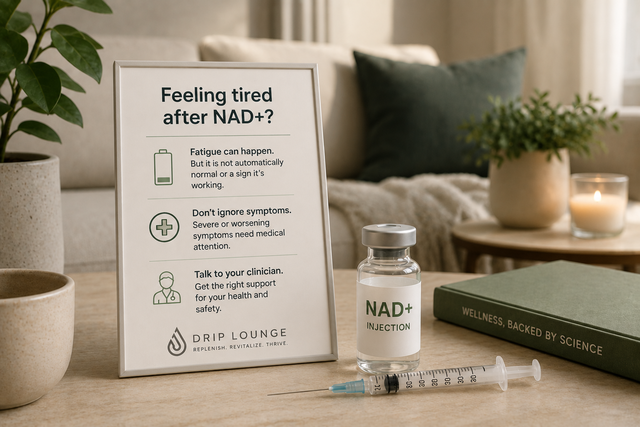
Feeling tired after NAD+ educational sign beside an NAD+ injection vial and syringe in a Drip Lounge wellness setting

¿Pueden las inyecciones de NAD+ causarle cansancio? Fatiga y seguridad explicadas

Sep 7, 2026 | IV Therapy

Yes, feeling tired or generally unwell can occur after an NAD+ injection or infusion. But fatigue after NAD+ should not automatically be considered “normal,” dismissed as a detox reaction, or interpreted as proof that the treatment is working.

NAD+ is often discussed online in connection with energy and cellular metabolism, which can make post-treatment fatigue feel especially confusing.

Someone may expect to feel energized and instead notice:

  • tiredness;
  • low energy;
  • dizziness;
  • nausea;
  • headache;
  • weakness;
  • brain fog;
  • or simply feeling unwell.

The reason cannot usually be determined from fatigue alone.

It could have several explanations, including the administration experience, another health condition, concurrent medications or supplements, or—in some situations—a concern involving the quality of an injectable product.

FDA has specifically reported adverse events following NAD+ injectable drugs that included severe chills, shaking, vomiting, and fatigue, with some cases requiring medical treatment. FDA's communication focused on risks associated with inappropriate ingredients and excessive endotoxin exposure in sterile compounding.

At Drip Lounge, symptoms after an NAD+ treatment should be taken seriously rather than explained away as a wellness reaction.

If you're researching NAD+ before treatment rather than because you're currently experiencing symptoms, you can also read What Is NAD+ IV Therapy? for a broader introduction to NAD+, IV administration, evidence, and clinical considerations.

Written by: Drip Lounge Editorial Team
Medically reviewed by: Megan Nickerson, DNP
Last medically reviewed: September 2026
Last updated: September 2026

Medical note: This article provides general education and cannot diagnose the cause of fatigue after an NAD+ injection or IV. Injectable NAD+ products may be compounded and are not FDA-approved finished drug products for general wellness, anti-aging, energy, or fatigue treatment. If you feel severely unwell or develop concerning symptoms after an injection or infusion, seek appropriate medical care.

NAD+ Fatigue at a Glance

QuestionShort Answer
Can NAD+ injections make you tired?Fatigue has been reported, but the cause cannot be assumed
Is fatigue proof NAD+ is working?No
Is it a “detox reaction”?That is not an established medical explanation
Should you repeat a dose if you feel tired?Do not self-redose after a concerning reaction; contact your clinician
Can product quality matter?Yes, particularly for sterile injectable products
Are injection and IV reactions identical?Not necessarily
Is injectable NAD+ well studied for wellness?Human evidence remains limited
When should you seek care?If symptoms are severe, worsening, persistent, or occur with red flags

The Short Answer: Can NAD+ Injections Make You Tired?

Yes. Fatigue or malaise may occur following NAD-related treatment, but “tired after NAD+” is not specific enough to identify why it happened.

A healthcare professional may need to consider:

  • when the fatigue began;
  • whether the NAD+ was injected or administered intravenously;
  • what other symptoms occurred;
  • current health conditions;
  • medications and supplements;
  • food and fluid intake;
  • product source;
  • and whether there could be an acute reaction or product-quality concern.

One important evidence caveat is that much of the published NAD literature does not study injectable NAD+ directly.

A 2024 systematic review reported adverse effects including fatigue, sleep disturbance, headache, muscle pain, and nervous-system symptoms across NAD-related interventions. However, the randomized trials included in that review used oral NADH or NAD precursors, not standard injectable NAD+ wellness protocols. Those findings therefore cannot be used to calculate the likelihood of fatigue after an NAD+ injection.

That distinction matters.

An oral NADH trial and an injectable NAD+ product are not interchangeable evidence.

Why Might Someone Feel Tired After NAD+?

It is not possible to diagnose the cause of post-injection fatigue from an article.

The possibilities below are things a clinician may consider—not explanations that should automatically be assumed.

1. Fatigue May Occur as Part of a Broader Reaction

Some people describe feeling generally unwell around NAD+ administration.

Symptoms discussed in NAD-related clinical and safety literature can include:

  • fatigue;
  • nausea;
  • headache;
  • dizziness;
  • gastrointestinal discomfort;
  • flushing;
  • sweating;
  • malaise;
  • or other unpleasant sensations.

Feeling tired afterward may occur alongside those symptoms.

But severity matters.

Feeling temporarily tired is different from:

  • severe weakness;
  • uncontrollable shaking;
  • fever;
  • repeated vomiting;
  • fainting;
  • chest discomfort;
  • breathing problems;
  • or confusion.

Those symptoms need a different level of attention.

2. The Administration Experience May Have Been Difficult

An NAD+ injection and an NAD+ IV are different routes of administration.

With an IV, the patient is exposed through an infusion process and may experience symptoms during treatment.

With an injection, the route, treatment setting, formulation, and monitoring process are different.

A reaction may potentially be influenced by several factors, including:

  • individual sensitivity;
  • formulation;
  • concurrent medications or supplements;
  • underlying health conditions;
  • administration circumstances;
  • or other symptoms occurring at the same time.

It is not appropriate to assume online that one particular factor caused the reaction.

If you're trying to understand what may happen specifically after an injection, see NAD+ Injection Effects and Timeline.

If symptoms occur during a supervised treatment, tell the clinical team immediately rather than trying to tolerate significant discomfort.

3. Something Other Than NAD+ May Be Causing the Fatigue

Fatigue is one of the least specific symptoms in medicine.

It can occur with:

  • poor sleep;
  • stress;
  • viral or bacterial illness;
  • dehydration;
  • insufficient food intake;
  • alcohol use;
  • anemia;
  • thyroid conditions;
  • blood-glucose abnormalities;
  • medication side effects;
  • mood disorders;
  • sleep disorders;
  • nutritional deficiencies;
  • and many other health conditions.

So there are two mistakes to avoid.

The first is:

“I felt tired after NAD+, so NAD+ definitely caused it.”

The second is:

“It happened after NAD+, but it is probably just detox, so I can ignore it.”

Neither conclusion is reliable without considering the broader clinical picture.

Persistent, recurrent, or unexplained fatigue deserves appropriate evaluation.

Product Quality and Sterile Compounding Matter

This is one of the most important—and often overlooked—parts of the NAD+ safety conversation.

Injectable products require appropriate controls around:

  • ingredient quality;
  • preparation;
  • sterility;
  • handling;
  • storage;
  • and dispensing.

FDA has specifically warned compounders about using ingredients unsuitable for sterile compounding.

The agency reported that some compounders had used food-grade NAD+ ingredients to make intravenous products. FDA explained that food-grade ingredients are not appropriate for sterile compounding without suitable processing because of contamination risks involving microbes and endotoxins.

FDA also reported adverse events following NAD+ injectable drugs that included:

  • severe chills;
  • shaking;
  • vomiting;
  • and fatigue.

Some patients required medical treatment. FDA said those reactions were consistent with excessive endotoxin exposure.

That does not mean endotoxin exposure explains every case of fatigue after NAD+.

It means product quality belongs in the safety assessment.

If You Suspect a Product-Quality Problem

Do not simply use more of the product and see whether the reaction happens again.

Preserve information such as:

  • product packaging;
  • vial;
  • pharmacy information;
  • lot number, if available;
  • date and time used;
  • route of administration;
  • and symptoms experienced.

Contact the clinician and dispensing pharmacy involved in your care.

If symptoms are severe or rapidly worsening, seek medical evaluation.

When Fatigue After NAD+ May Be a Red Flag

Seek urgent medical care if fatigue occurs with:

  • Trouble breathing, wheezing, facial or throat swelling, or a widespread rash
  • Chest pain, chest pressure, severe palpitations, or a very fast or irregular heartbeat
  • Fainting, near-fainting, new confusion, severe weakness, or difficulty staying awake
  • High fever, severe chills, or uncontrollable shaking
  • Persistent vomiting or inability to keep fluids down
  • Severe abdominal pain or severe diarrhea
  • A severe headache accompanied by weakness, speech difficulty, vision changes, or confusion
  • Severe pain, spreading redness, warmth, swelling, drainage, or streaking around an injection site
  • Symptoms that are rapidly worsening or not improving

If you believe you may be experiencing a medical emergency, call 911 or seek emergency care.

FDA's reports of severe chills, shaking, vomiting, and fatigue after NAD+ injectable drugs are an important reason these symptoms should not automatically be described as a harmless “wellness reaction.”

What Should You Do If You Feel Tired After an NAD+ Injection?

If you feel unexpectedly tired, dizzy, nauseated, weak, or otherwise unwell following NAD+ treatment:

  1. Do not repeat the treatment on your own after a concerning reaction.
  2. Contact the clinician or pharmacy involved in your care.
  3. Describe exactly what happened and when symptoms began.
  4. Keep product and lot information if available.
  5. Tell the clinician about other medications and supplements you use.
  6. Seek prompt medical evaluation if symptoms persist, worsen, or occur with any red flags.

This article cannot determine whether your individual symptoms are mild or medically significant.

When uncertain, contacting a healthcare professional is safer than trying to troubleshoot the reaction yourself.

If NAD+ Was Administered in a Clinic

Tell the clinical team immediately if you feel unwell during treatment.

The clinician can assess:

  • symptoms;
  • timing;
  • vital signs where appropriate;
  • relevant medical history;
  • and whether additional evaluation is necessary.

Significant discomfort should not be reframed as something you simply need to endure.

If NAD+ Was Used Outside the Clinic

Do not attempt to solve a reaction by independently changing:

  • dose;
  • frequency;
  • route;
  • or administration technique.

Contact the prescribing clinician or dispensing pharmacy.

Seek urgent care for severe, sudden, or worsening symptoms.

People considering a home-based NAD pathway should understand the clinical process before deciding whether it is appropriate. Drip Lounge provides additional information about its NAD+ Injection Kit, but eligibility requires clinical review and the service is not appropriate for every person.

Is Fatigue After NAD+ a Sign That It Is Working?

No.

There is no reliable medical basis for interpreting fatigue after an NAD+ injection as proof that treatment is successfully:

  • “detoxing” the body;
  • repairing cells;
  • removing toxins;
  • resetting mitochondria;
  • reversing aging;
  • or improving health.

Those explanations may sound persuasive online, but they are not established clinical interpretations of post-injection fatigue.

A symptom can be temporary without being beneficial.

A responsible clinical approach is:

notice the symptom → assess its severity → consider the context → determine whether further care is needed

rather than:

feel worse → assume treatment must be working

NAD+ Fatigue: Myth vs. Fact

MythWhat the Evidence Supports
“Feeling exhausted means NAD+ is working.”Fatigue is non-specific and may represent a reaction or an unrelated health issue
“A detox reaction is expected.”“Detox” is not a medical diagnosis for post-injection symptoms
“Every NAD+ injectable product is the same.”Source, formulation, sterile preparation and clinical oversight can differ
“If the symptoms go away, they do not matter.”Reactions should still be documented and discussed before further treatment
“More NAD+ will fix the fatigue.”Do not self-adjust treatment after a concerning reaction
“NAD+ is naturally in the body, so injections must be safe.”Normal biological function does not establish safety of an injectable product or route

What Does Research Actually Tell Us About Injectable NAD+?

NAD+, or nicotinamide adenine dinucleotide, is a coenzyme involved in essential cellular processes including redox reactions and energy metabolism.

That biological importance is real.

But this statement:

“NAD+ is essential for normal cellular metabolism.”

does not automatically prove this statement:

“Injectable NAD+ improves wellness, energy, fatigue, longevity, or aging outcomes.”

A 2026 PRISMA-guided systematic review examined NAD-related interventions across human and animal studies. The researchers found that human studies of oral NAD+ precursors demonstrated biological effects, but clinical outcomes were inconsistent. Importantly, the review found no eligible outcomes trials evaluating intravenous or intramuscular NAD+ itself for anti-aging or wellness indications.

The authors concluded that the clinical effectiveness of NAD+ augmentation for wellness and anti-aging remains inconclusive and that stronger trials are particularly needed for parenteral approaches.

A more recent 2026 review similarly described intravenous NAD+ administration as less well characterized and lacking robust clinical validation.

So the evidence-based answer is not:

“NAD+ injections definitely work.”

Nor is it:

“NAD+ injections definitely do nothing.”

It is:

Human evidence for injectable NAD+ in broad wellness settings remains limited, and more rigorous research is needed.

Why the Route of Administration Matters

Not all NAD-related products are equivalent.

There are important differences among:

  • NAD+ injections;
  • NAD+ IV therapy;
  • NAD precursors;
  • oral supplements;
  • patches;
  • and other delivery formats.

Studies of one route should not automatically be used as evidence for another.

For example, the 2024 systematic review that reported fatigue and sleep disturbance involved oral interventions. It should not be cited as though it measured adverse events from injectable NAD+.

Likewise, research on oral precursors cannot establish the safety of an injectable NAD+ formulation.

If you're comparing different NAD formats, useful Drip Lounge resources include NAD+ Transdermal Patches vs. IV Infusions and Niagen IV vs. NAD+ IV.

NAD+ IV vs. NAD+ Injections: Should You Switch Routes After Fatigue?

Do not assume switching routes solves a reaction.

An injection and an IV involve different:

  • administration routes;
  • treatment settings;
  • formulations;
  • monitoring processes;
  • and exposure patterns.

If you experienced fatigue or another concerning symptom after one route, the first question should be:

What happened and does it need clinical evaluation?

not:

Which route should I try next?

A change in route is a clinical decision, not a self-directed solution to a side effect.

For more information about the IV route, see What Is NAD+ IV Therapy? or review Drip Lounge's NAD+ IV Therapy options.

You may also find our guide to NAD+ IV therapy side effects useful for infusion-specific safety context.

Questions to Ask Before Using an Injectable NAD+ Product

QuestionWhy It Matters
Who is prescribing or supervising it?Injectable products require appropriate clinical oversight
Where does the product come from?Product identity and quality matter
Is it dispensed through an appropriately licensed pharmacy?Sterile preparation standards matter
What health information do you need from me first?Medical history and medications may affect appropriateness
What symptoms require me to stop and seek care?Patients need a clear escalation pathway
Who do I contact if I feel unwell afterward?Safety planning should continue after administration
How are adverse events documented?Reactions should be recorded and assessed
What is not known about injectable NAD+?Informed consent should include uncertainty
Are there better-established options for my actual health concern?The goal should determine the care pathway

Considering an NAD+ Injection Kit?

The appropriate starting point is not choosing an injectable product because it is marketed for “energy” or “longevity.”

A licensed clinician should first consider:

  • your health history;
  • current medications;
  • current symptoms;
  • goals;
  • relevant safety concerns;
  • and whether the treatment route is appropriate.

You can learn more about Drip Lounge's NAD+ Injection Kit and the clinical pathway involved.

Availability, eligibility, prescribing, and service areas depend on clinical review and applicable law. This article does not establish that an NAD+ Injection Kit is appropriate for you.

Frequently Asked Questions

Can NAD+ Injections Make You Tired?

Yes, fatigue or malaise may occur following NAD-related treatment. FDA has also reported fatigue among adverse events involving some NAD+ injectable drugs. However, fatigue is non-specific, and the timing, severity, associated symptoms, health history, and product details should be considered.

Is It Normal to Feel Tired After an NAD+ Injection?

Do not automatically assume it is “normal.”

Some symptoms may be temporary, but fatigue that is severe, persistent, worsening, or accompanied by other concerning symptoms should be discussed with a healthcare professional.

Why Do I Feel Tired After NAD+?

There is no single explanation that applies to everyone.

A clinician may consider the administration experience, other symptoms, medications, underlying health conditions, food and fluid intake, product source, and whether an acute reaction or unrelated health issue may be present.

Does NAD+ Cause a Detox Reaction?

“Detox reaction” is not an established medical diagnosis for fatigue, nausea, shaking, chills, vomiting, or other symptoms following NAD+ treatment.

Those symptoms should not be dismissed as evidence that treatment is working.

Can NAD+ Injections Cause Chills, Shaking, or Vomiting?

FDA has received reports of severe chills, shaking, vomiting, and fatigue following NAD+ injectable drugs, with some patients requiring medical treatment. FDA discussed these reports in the context of sterile-compounding and endotoxin concerns.

What Should I Do If I Feel Tired After NAD+?

Do not repeat treatment on your own after a concerning reaction.

Contact the treating clinician or pharmacy, document what happened, and seek medical care promptly if symptoms are severe, persistent, worsening, or occur with red flags.

Can I Switch From NAD+ Injections to NAD+ IV if I Feel Tired?

Do not make that decision on your own.

The routes are not interchangeable, and a clinician should assess your reaction before another NAD+ treatment is considered.

Is Injectable NAD+ FDA-Approved for Energy or Anti-Aging?

There is no FDA-approved finished injectable NAD+ drug for general energy, wellness, anti-aging, or fatigue treatment. A 2026 systematic review also found no eligible outcomes trials evaluating IV or IM NAD+ itself for anti-aging or wellness indications.

Does Feeling Tired Mean I Need More NAD+?

No reliable evidence supports using fatigue after an injection as a sign that you need more NAD+.

Do not self-redose to treat a reaction.

Should I Use an NAD+ Injection Kit if I Already Have Fatigue?

Unexplained, persistent, recurrent, or severe fatigue has many possible causes and should not automatically be self-treated with an injectable wellness product.

Discuss the symptom with a qualified clinician first.

Related NAD+ Education

TopicDrip Lounge Resource
NAD+ injection experienceNAD+ Injection Effects and Timeline
NAD+ Injection KitExplore the NAD+ Injection Kit
NAD+ IV basicsWhat Is NAD+ IV Therapy?
NAD+ IV serviceNAD+ IV Therapy
NAD+ IV side effectsNAD+ IV Therapy Side Effects
NAD+ patches vs. IVNAD+ Patches vs. IV Infusions
Niagen vs. NAD+ IVNiagen IV vs. NAD+ IV
NAD+ patchesIntroducing NAD+ Transdermal Patches
Oral NAD supportNAD Support Capsules

Sources Reviewed

This article was reviewed against current regulatory and peer-reviewed evidence.

  • U.S. Food and Drug Administration — Sterile Compounding Safety Communication. FDA reported adverse events after NAD+ injectable drugs including severe chills, shaking, vomiting, and fatigue and warned against using unsuitable food-grade ingredients in sterile compounding.
  • Gallagher C, Emmanuel OO. NAD+ Supplementation for Anti-Aging and Wellness: A PRISMA-Guided Systematic Review. Ageing Research Reviews, 2026. The review found no eligible outcomes trials of intravenous or intramuscular NAD+ itself for anti-aging or wellness indications and concluded that clinical effectiveness remains inconclusive.
  • Gindri IDM, et al. Evaluation of Safety and Effectiveness of NAD in Different Clinical Conditions: A Systematic Review. American Journal of Physiology-Endocrinology and Metabolism, 2024. Fatigue, sleep disturbance, headache, and other adverse events were reported across included studies, but the randomized interventions used oral NADH or NAD precursors, so these findings should not be interpreted as direct injection-safety data.
  • NAD+ Biology and Supplementation: From Mechanisms to Clinical Perspectives, 2026. The review describes intravenous NAD+ as less well characterized and lacking robust clinical validation.

Recommended medical review cadence: Every 90 days and immediately after significant FDA safety communications or meaningful new evidence involving injectable NAD+.

The Bottom Line: Can NAD+ Make You Tired?

Yes, fatigue or feeling unwell may occur after NAD+ treatment, but tiredness is not specific enough to tell you why it happened.

It should not automatically be labeled:

  • normal;
  • detox;
  • cellular repair;
  • a healing crisis;
  • an “energy crash”;
  • or evidence that NAD+ is working.

FDA has reported fatigue alongside more significant reactions—including severe chills, shaking, and vomiting—following some NAD+ injectable products.

At the same time, current clinical research on injectable NAD+ for broad wellness purposes remains limited. A 2026 systematic review found no eligible outcomes trials directly evaluating IV or IM NAD+ itself for anti-aging or wellness indications.

The safest approach is therefore simple:

Take the symptom seriously, consider the context, and ask a clinician rather than trying to explain it yourself.

If fatigue is severe, persistent, worsening, or accompanied by shaking, fever, vomiting, chest discomfort, trouble breathing, fainting, confusion, or severe dizziness, seek medical care promptly.

For non-emergency questions, a clinician can review what happened and determine whether further evaluation is appropriate before any future injectable treatment is considered.

Learn About Clinician-Guided NAD+ Support

If you are considering NAD+ and are not currently experiencing an acute reaction, you can review the NAD+ Injection Kit or learn about NAD+ IV Therapy.

Learn About the NAD+ Injection Kit · Explore NAD+ IV Therapy

Eligibility and treatment decisions require individual clinical review. These services are not substitutes for medical evaluation of unexplained or acute fatigue.

Back to IV Therapy
Dr. Megan Nickerson, DNP, smiling in a bright clinical setting

Meet Megan

Dr. Megan Nickerson, DNP

Doctor & Managing Partner | Drip Lounge

We are incredibly proud to have Megan leading our clinical care. Known for her infectious smile and unwavering professionalism, she has built a reputation as a deeply trustworthy expert who makes every client feel safe and seen.

About

Dr. Nickerson brings over a decade of hands-on clinical experience - from transplant and critical care units to gastroenterology, rheumatology, and specialized infusion services. Her transition into wellness wasn't a departure from medicine; it was an extension of it. At Drip Lounge, she applies the same diagnostic discipline and safety standards she developed in high-stakes hospital environments to deliver care that is thoughtful, precise, and deeply personalized.

Contact Now

(845) 391-0338 | info@driploungehealth.com
5177 Route 9W, Suite 2, Newburgh NY 12550

Contact details

Your message