Labor Day Sale: 50% off consultations · 25% off peptides · Buy one IV, get one free (excl. NAD+)Book now
Drip Lounge
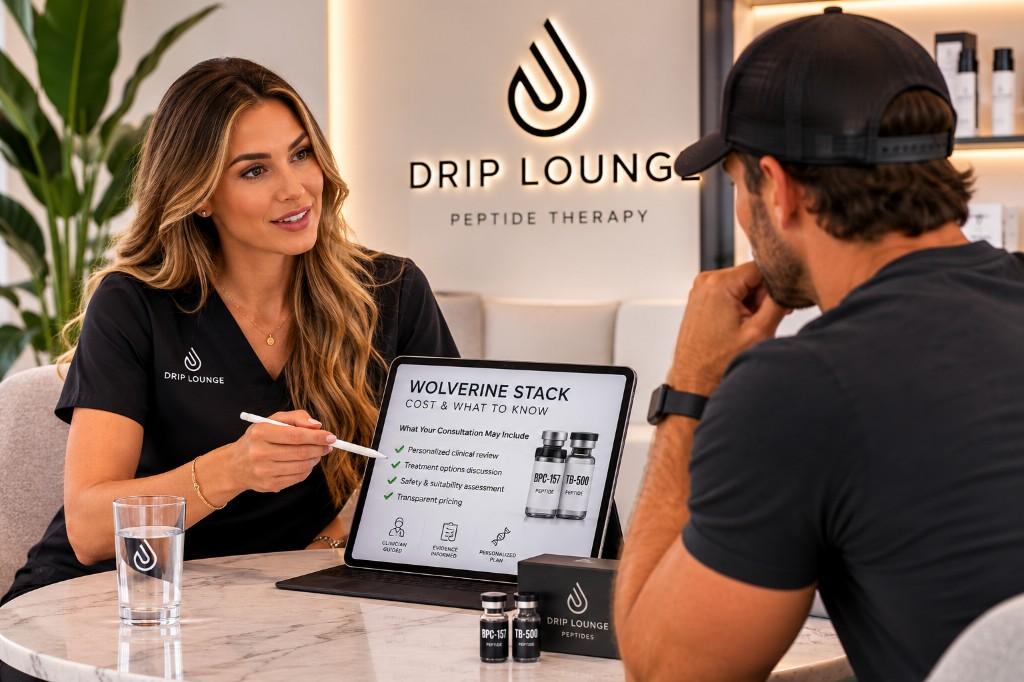
Drip Lounge clinician reviewing a Wolverine Stack cost and consultation guide on a tablet with BPC-157 and TB-500 vials on the table

Wolverine Stack Cost: Consultation, Pricing & What to Know

Sep 9, 2026 | Peptides

There is no universal, medically standardized Wolverine Stack price. The term “Wolverine Stack” is commonly used online for a combination involving BPC-157 and TB-500, but the combination is not an FDA-approved medication or standardized FDA-approved treatment program.

That makes cost more complicated than comparing the retail price of two approved medications.

Someone researching Wolverine Stack cost may actually be comparing very different things: an initial clinician consultation, medical-history review, injury or recovery assessment, laboratory testing when appropriate, follow-up care, pharmacy-related costs where legally applicable, or completely unverified products sold online.

At Drip Lounge, the first question should not be:

“How quickly can I get the Wolverine Stack?”

It should be:

“What am I actually trying to address, what does the evidence support, and what is the appropriate clinical next step?”

If you are still learning what this combination refers to, you can first review the Wolverine Stack overview or explore the broader healing and recovery peptide category.

Written by: Drip Lounge Editorial Team
Medically reviewed by: Megan Nickerson, DNP
Last medically reviewed: September 2026
Regulatory status reviewed: September 2026

Medical disclaimer: This article is educational only. It does not recommend BPC-157, TB-500, the Wolverine Stack, or any specific peptide protocol. It does not provide dosing, self-administration, prescribing, compounding, or purchasing instructions. Treatment decisions should be discussed with a qualified healthcare professional.

Wolverine Stack Cost at a Glance

QuestionShort Answer
Is there a standard Wolverine Stack price?No
Is the Wolverine Stack FDA-approved?No
Are BPC-157 and TB-500 FDA-approved human drugs?No
Can consultation fees vary?Yes
Can labs, imaging, or referrals add cost?Potentially
Does a consultation guarantee peptide treatment?No
Does insurance automatically cover it?No
Should exact fees be explained before payment?Yes
Should cost be the only factor?No—evidence, sourcing, safety, and clinical appropriateness matter

FDA currently identifies unresolved safety issues involving both BPC-157 and the thymosin-beta-4 fragment commonly referred to as TB-500 in the compounding context. For BPC-157, FDA cites limited safety information, possible immunogenicity, peptide-related impurities, and API-characterization concerns. For TB-500, FDA states that it has not identified human exposure data sufficient to characterize safety and notes potential immunogenicity and peptide-impurity concerns.

How Much Does the Wolverine Stack Cost?

There is no evidence-based universal Wolverine Stack cost.

Unlike an FDA-approved medication with a standardized commercial product, labeled indication, and established prescribing information, “Wolverine Stack” is an informal name used for a combination of experimental peptides.

That means a statement such as:

“The Wolverine Stack costs $X per month.”

can be misleading unless the clinic clearly explains what the amount actually covers.

The total might refer to:

  • a consultation;
  • medical-history review;
  • injury or symptom assessment;
  • follow-up appointments;
  • laboratory work;
  • review of existing imaging;
  • rehabilitation guidance;
  • referral to another clinician;
  • or another component of care.

It should not be presented as though every patient receives the same peptide combination for the same price.

A consultation also does not guarantee that BPC-157, TB-500, another peptide, or any particular treatment will be recommended.

What Are You Actually Paying For?

This is the more useful question.

A high-quality clinical experience should provide value before any specific treatment is selected.

Depending on the situation, a clinician-guided recovery evaluation may involve several components.

1. Clinical Consultation

A clinician may review:

  • your main concern;
  • injury or symptom history;
  • current level of activity;
  • medications;
  • supplements;
  • allergies;
  • previous treatment;
  • relevant medical conditions;
  • previous injuries or surgeries;
  • and your recovery goals.

That assessment matters because “I want the Wolverine Stack” and “I have an injury that needs appropriate evaluation” are not necessarily the same problem.

2. Injury and Recovery Assessment

Some people researching Wolverine Stack pricing are athletes looking for general recovery support.

Others may have:

  • persistent tendon pain;
  • ligament injuries;
  • joint discomfort;
  • post-operative symptoms;
  • nerve-related symptoms;
  • limited mobility;
  • or an undiagnosed injury.

Those situations should not automatically receive the same clinical pathway.

If your interest is specifically related to tendon or ligament recovery, our educational guide to peptides for tendon and ligament healing can help you understand the evidence and limitations before discussing treatment options.

3. Review of Previous Care

A clinician may also want to understand what you have already tried.

That can include:

  • physical therapy;
  • rest;
  • activity modification;
  • rehabilitation;
  • anti-inflammatory medication;
  • injections;
  • orthopedic treatment;
  • surgery;
  • or other interventions.

A peptide should not automatically replace a more appropriate evidence-based treatment simply because it is newer or more heavily marketed online.

4. Imaging or Medical-Record Review

Some recovery concerns may require review of:

  • MRI results;
  • X-rays;
  • ultrasound;
  • orthopedic notes;
  • surgical reports;
  • or physical-therapy documentation.

In some situations, additional diagnostic evaluation may be more important than discussing a peptide.

5. Laboratory Testing

Laboratory testing is not automatically necessary for every recovery concern.

When testing is clinically indicated, however, it may represent an additional expense.

Before agreeing to care, ask:

  • Is testing necessary?
  • Is it included?
  • Is it billed separately?
  • Is an external laboratory used?
  • Could insurance apply?
  • Will I know the cost beforehand?

6. Follow-Up and Monitoring

Responsible care may involve follow-up rather than a one-time appointment.

The purpose could include reviewing:

  • symptoms;
  • function;
  • treatment tolerance;
  • recovery progress;
  • rehabilitation;
  • new medical information;
  • or whether another specialist should become involved.

A lower upfront price does not necessarily mean better value if there is no meaningful clinical follow-up.

How Much Does a Wolverine Stack Consultation Cost?

Consultation fees can vary depending on:

  • whether you are a new or existing patient;
  • appointment length;
  • clinician involvement;
  • complexity of the concern;
  • whether medical records need review;
  • whether imaging is involved;
  • and whether additional follow-up is required.

For Drip Lounge, the safest approach is to publish an exact consultation price only when that amount and its inclusions have been verified by the clinical and billing teams.

The price explanation should be straightforward:

Your consultation covers [verified services]. It does not guarantee eligibility for a medication, peptide, pharmacy service, laboratory test, or particular outcome.

This is more transparent than presenting an unexplained “Wolverine Stack package.”

Why Does Wolverine Stack Pricing Vary So Much?

Search online and you may find dramatically different prices.

One reason is that sellers may not be offering equivalent products or services.

A price could refer to:

  • a clinical consultation;
  • a legitimate medical evaluation;
  • a vial sold by an online peptide vendor;
  • a product labeled “research use only”;
  • an overseas supplier;
  • an unverified “peptide clinic” package;
  • or an ongoing medical program.

Comparing these prices as though they represent the same thing is not meaningful.

The cheapest option may have no clinician evaluation at all.

The most expensive option is not automatically the highest quality either.

The useful question is:

What exactly is included, who is responsible for my care, and how has the product or treatment pathway been verified?

What Is the Wolverine Stack?

The term Wolverine Stack is commonly used to describe a combination involving:

  • BPC-157
  • and TB-500, usually referring to a thymosin-beta-4 fragment.

Neither the name “Wolverine Stack” nor the combination itself represents an FDA-approved standardized treatment.

BPC-157 has attracted substantial interest in preclinical research involving gastrointestinal tissue, wound biology, tendons, ligaments, and other areas.

You can review Drip Lounge’s BPC-157 information page for additional context.

However, research interest and animal data should not be converted into guarantees that BPC-157 will heal a particular injury in humans.

The same caution applies to TB-500.

Are BPC-157 and TB-500 FDA-Approved?

No.

Neither BPC-157 nor the TB-500/thymosin-beta-4 fragment is an FDA-approved human drug.

FDA’s current safety page states that compounded BPC-157 may pose immunogenicity risks for certain administration routes and may involve complexities related to peptide impurities and active-pharmaceutical-ingredient characterization. FDA also says safety-related information is absent or limited for proposed routes, leaving insufficient information to determine whether the substance may cause harm in humans.

For the thymosin-beta-4 fragment also known as TB-500, FDA states that it has not identified human exposure data for drug products containing the fragment and lacks important safety information, including whether it could cause harm when administered to humans.

This does not mean those substances have been proven harmful in every context.

It means the evidence is insufficient to treat them like established FDA-approved therapies.

For a deeper safety overview, see Wolverine Stack Side Effects.

What Happened With the FDA Review in 2026?

This is important because online discussions can easily misrepresent regulatory events.

In July 2026, FDA’s Pharmacy Compounding Advisory Committee considered BPC-157-related and TB-500-related bulk drug substances for possible inclusion on the 503A Bulks List.

That process does not mean BPC-157 or TB-500 became FDA-approved medications.

FDA explains that advisory committees provide independent recommendations, but those recommendations are non-binding, and FDA is not legally required to follow them.

FDA’s own briefing materials also state that it does not intend to issue a final determination until advisory-committee input and the remaining review process have been completed.

So statements such as:

“FDA approved BPC-157 in July 2026”

or

“TB-500 became FDA-approved after the committee meeting”

would be inaccurate.

The regulatory status should be checked again before publication and periodically afterward.

Why FDA Status Matters When Comparing Prices

Someone comparing Wolverine Stack prices may encounter sellers describing products as:

  • “pharmaceutical grade”;
  • “research grade”;
  • “99% pure”;
  • “doctor formulated”;
  • “clinic quality”;
  • or “compounded.”

Those descriptions do not automatically establish that the product has undergone FDA review.

FDA-approved drugs undergo a regulatory process evaluating specific products and approved uses.

Compounded medications are not FDA-approved products and do not undergo FDA’s premarket approval process for safety, effectiveness, and quality.

For experimental peptides, the price should therefore never be evaluated independently from questions of:

  • identity;
  • purity;
  • concentration;
  • sterility;
  • storage;
  • pharmacy oversight;
  • manufacturer or compounder;
  • clinician oversight;
  • and regulatory compliance.

This is why Drip Lounge’s broader healing and recovery peptide pathway should be approached as clinician-guided education and assessment rather than a simple product catalog. See also Where to Buy Wolverine Stack Peptides.

Is a Cheaper Wolverine Stack a Better Deal?

Not necessarily.

A low-cost vial from an anonymous website could raise basic questions:

  • Is it actually BPC-157?
  • Is it actually TB-500?
  • Is the concentration accurate?
  • Is it sterile?
  • Are contaminants present?
  • Was it stored correctly?
  • Who produced it?
  • Was a qualified pharmacy involved?
  • Who helps if you experience a reaction?

A cheap price cannot answer those questions.

At the same time, a high price does not automatically establish quality.

The better comparison is not:

Cheap vs. expensive

It is:

Verified clinical care vs. an unverified product or protocol.

What Should a Quality Recovery Consultation Include?

A useful consultation should remain valuable even if the clinician decides a peptide is not the appropriate next step.

Health and Injury Review

Your symptoms, previous injuries, medications, supplements, allergies, and current health conditions should be discussed.

Functional Goals

“Recovery” can mean very different things.

One person may want to return to running.

Another may want to lift again after a tendon injury.

Another may simply be sore after training.

The treatment pathway should reflect the actual problem.

Evidence Discussion

A responsible clinician should explain:

  • what evidence exists;
  • whether the evidence is human or preclinical;
  • what remains uncertain;
  • and the regulatory status of the treatment being considered.

Alternative Options

Appropriate alternatives may include:

  • rehabilitation;
  • physical therapy;
  • sports medicine;
  • orthopedic evaluation;
  • activity modification;
  • pain management;
  • or another treatment supported by stronger evidence.

Follow-Up Plan

You should understand what happens next, whether treatment is recommended or not.

Does Paying for a Consultation Guarantee a Wolverine Stack Prescription?

No.

A clinician consultation should never guarantee:

  • BPC-157;
  • TB-500;
  • a particular peptide;
  • a compounded product;
  • a specific stack;
  • automatic approval;
  • medication shipment;
  • or a particular result.

The purpose of the consultation is to determine what is appropriate.

That includes the possibility that the clinician recommends another path.

If you want to understand the broader treatment category before booking, you can explore Drip Lounge’s peptide therapy hub.

Who May Want to Start With a Consultation Instead?

A clinician-guided recovery consultation may make more sense than attempting to select a peptide yourself if:

  • you have persistent pain;
  • you are unsure what caused the problem;
  • previous treatment has not helped;
  • you have a recurring injury;
  • you are returning to sport after an injury;
  • your symptoms limit normal activity;
  • you have several medications or medical conditions;
  • or you are comparing multiple recovery options and want help understanding the evidence.

The goal should not be to make everyone a Wolverine Stack candidate.

It should be to make the right next step obvious.

Choose Another Path First If…

The Wolverine Stack should not be the starting point for every recovery concern.

Another clinical pathway may make more sense if:

  • you have not yet received an appropriate diagnosis;
  • the injury followed significant trauma;
  • you have major weakness or loss of function;
  • you suspect a fracture or tendon rupture;
  • symptoms are rapidly worsening;
  • significant swelling is present;
  • you have neurological symptoms;
  • you need rehabilitation rather than another wellness product;
  • or your goal can reasonably be addressed with a simpler, lower-commitment approach.

A good consultation is allowed to end with:

“This is not the treatment you need.”

That is a sign of responsible clinical care, not a failed sale.

Does Insurance Cover the Wolverine Stack?

Insurance coverage should not be assumed.

Because the Wolverine Stack is not an FDA-approved standardized treatment, patients should not expect insurance to automatically cover BPC-157, TB-500, or a peptide recovery package.

However, other components of care may have separate insurance rules.

Depending on the plan and clinical situation, coverage might separately apply to:

  • medical evaluation;
  • diagnostic imaging;
  • physical therapy;
  • orthopedic consultation;
  • laboratory testing;
  • rehabilitation;
  • pain management;
  • or another medically necessary service.

Insurance depends on factors including:

  • plan design;
  • diagnosis;
  • network status;
  • deductible;
  • medical necessity;
  • prior authorization;
  • and the specific service being billed.

Drip Lounge should not promise reimbursement or coverage for the Wolverine Stack.

Patients should verify benefits directly with their insurer.

Will I Know the Cost Before I Decide?

You should know the confirmed costs associated with the services you agree to before treatment.

Useful questions include:

  • What does the consultation cost?
  • What is included?
  • Are follow-ups included?
  • Are labs separate?
  • Is imaging included?
  • Would I need another specialist?
  • Are pharmacy costs separate?
  • Will I know all confirmed costs before moving forward?
  • What happens if the clinician decides the requested treatment is not appropriate?

Transparent pricing reduces uncertainty.

It should not create the impression that payment guarantees a peptide.

What Should I Ask Before Paying?

Use this checklist before committing to any recovery program.

  1. What exactly am I paying for?
  2. Am I paying for a consultation or for treatment?
  3. Who will evaluate me?
  4. Will my actual injury or symptoms be reviewed?
  5. What evidence supports the treatments being discussed?
  6. What important limitations remain?
  7. What is the FDA status?
  8. Are lab tests additional?
  9. Are follow-ups additional?
  10. Where does any medication or compounded product come from?
  11. What alternatives should I consider?
  12. What happens if the clinician decides this is not right for me?
  13. What will I pay before anything begins?

You should be able to get clear answers.

When Should an Injury Be Medically Evaluated?

Why am I still hurting?

Consider appropriate medical evaluation when pain:

  • persists despite reasonable rest;
  • continues getting worse;
  • affects your gait or mobility;
  • limits normal daily activity;
  • causes significant weakness;
  • follows substantial trauma;
  • repeatedly returns;
  • is associated with major swelling;
  • or affects joint stability.

Urgent assessment may be necessary for:

  • sudden loss of function;
  • severe neurological symptoms;
  • suspected fracture;
  • suspected major tendon rupture;
  • major swelling following trauma;
  • fever with significant redness or swelling;
  • or another rapidly worsening symptom.

No peptide should be used as a substitute for diagnosing a serious injury.

Frequently Asked Questions

How Much Does the Wolverine Stack Cost?

There is no standardized or FDA-established Wolverine Stack price. Cost may differ depending on whether the person is paying for a consultation, medical evaluation, follow-up, laboratory testing, imaging, rehabilitation, referrals, or other clinically appropriate care.

How Much Is a Wolverine Stack Consultation?

Consultation fees depend on the practice, clinician, appointment type, and services involved. Drip Lounge should display an exact fee only after that price and its inclusions have been verified.

Are BPC-157 and TB-500 FDA-Approved?

No. Neither BPC-157 nor the TB-500/thymosin-beta-4 fragment is an FDA-approved human drug. FDA currently identifies unresolved safety and quality concerns involving both substances in the compounding context.

Is the Wolverine Stack FDA-Approved?

No. “Wolverine Stack” is an informal term for a peptide combination. It is not the name of an FDA-approved drug or standardized FDA-approved treatment.

Did FDA Approve BPC-157 in 2026?

No. BPC-157-related substances were discussed by FDA’s Pharmacy Compounding Advisory Committee in July 2026 as part of consideration for the 503A Bulks List. Advisory committee recommendations are non-binding and are not equivalent to FDA approval of a drug.

Does Insurance Cover BPC-157 or TB-500?

Coverage should not be assumed. Other medically necessary services—such as evaluation, imaging, physical therapy, or specialist care—may have separate insurance coverage depending on the patient’s plan.

Does a Consultation Guarantee Peptide Treatment?

No. The purpose of clinical evaluation is to determine what care is appropriate. A consultation does not guarantee BPC-157, TB-500, a Wolverine Stack, pharmacy service, or a specific outcome.

Why Are Wolverine Stack Prices So Different Online?

Prices may refer to completely different products and services. One may represent a clinical consultation while another may be an unverified online research product. Cost alone does not establish identity, purity, sterility, regulatory compliance, or quality.

Should I Buy BPC-157 or TB-500 From a Research Peptide Website?

A product marketed as “research use only” should not be assumed to be a safe, sterile, pharmaceutical-grade human treatment. Discuss your actual recovery concern with a qualified clinician instead of using online availability as proof that a product is appropriate.

Where Can I Learn More About BPC-157?

Drip Lounge provides a separate BPC-157 clinical information page where you can review the treatment context and discuss questions with the clinical team. You can also read How Long Does BPC-157 Take to Work?.

Where Can I Learn More About the Wolverine Stack?

You can review the Wolverine Stack information page or browse the broader Healing & Recovery peptide section.

Related Peptide and Recovery Resources

If you want help understanding recovery options in a clinician-guided setting, you can book a peptide consultation. A consultation does not guarantee eligibility for BPC-157, TB-500, or any specific peptide protocol.

Back to Peptides
Dr. Megan Nickerson, DNP, smiling in a bright clinical setting

Meet Megan

Dr. Megan Nickerson, DNP

Doctor & Managing Partner | Drip Lounge

We are incredibly proud to have Megan leading our clinical care. Known for her infectious smile and unwavering professionalism, she has built a reputation as a deeply trustworthy expert who makes every client feel safe and seen.

About

Dr. Nickerson brings over a decade of hands-on clinical experience - from transplant and critical care units to gastroenterology, rheumatology, and specialized infusion services. Her transition into wellness wasn't a departure from medicine; it was an extension of it. At Drip Lounge, she applies the same diagnostic discipline and safety standards she developed in high-stakes hospital environments to deliver care that is thoughtful, precise, and deeply personalized.

Contact Now

(845) 391-0338 | info@driploungehealth.com
5177 Route 9W, Suite 2, Newburgh NY 12550

Contact details

Your message